Organizational Culture Survey Template
Your company culture shapes how your team works, feels, and grows.
Use our organizational culture survey template to uncover what your employees really think—and build a stronger, more aligned workplace.
This article is designed to help HR professionals and organizational leaders evaluate their workplace culture using a professional, customizable survey template. It provides a ready-to-use questionnaire, explains the importance of assessing internal culture, and guides you step-by-step through deploying it using Porsline.
What Is an Organizational Culture Survey?
An organizational culture survey is a structured questionnaire designed to assess how employees perceive and experience the values, behaviors, communication styles, and leadership within their company. It offers direct insights into the "unwritten rules" and shared beliefs that influence how teams operate day-to-day.
This type of survey typically covers key areas such as trust, transparency, inclusivity, collaboration, recognition, and alignment with the company’s mission and goals. By asking employees about these aspects, companies can identify cultural strengths to reinforce—and gaps that may hinder performance or retention.
Whether you're a startup scaling fast or a large enterprise going through transformation, understanding your internal culture is critical for long-term success.
In short, an organizational culture Assessment template helps leaders decode their company’s identity from the employee perspective.
Why Use an Organizational Culture Survey?
Conducting an organizational culture survey isn't just a nice-to-have—it's a strategic move that drives real business value. Culture has a direct impact on employee engagement, performance, innovation, and retention. When culture aligns with business goals, teams thrive. When it doesn’t, friction, disengagement, and turnover often follow.
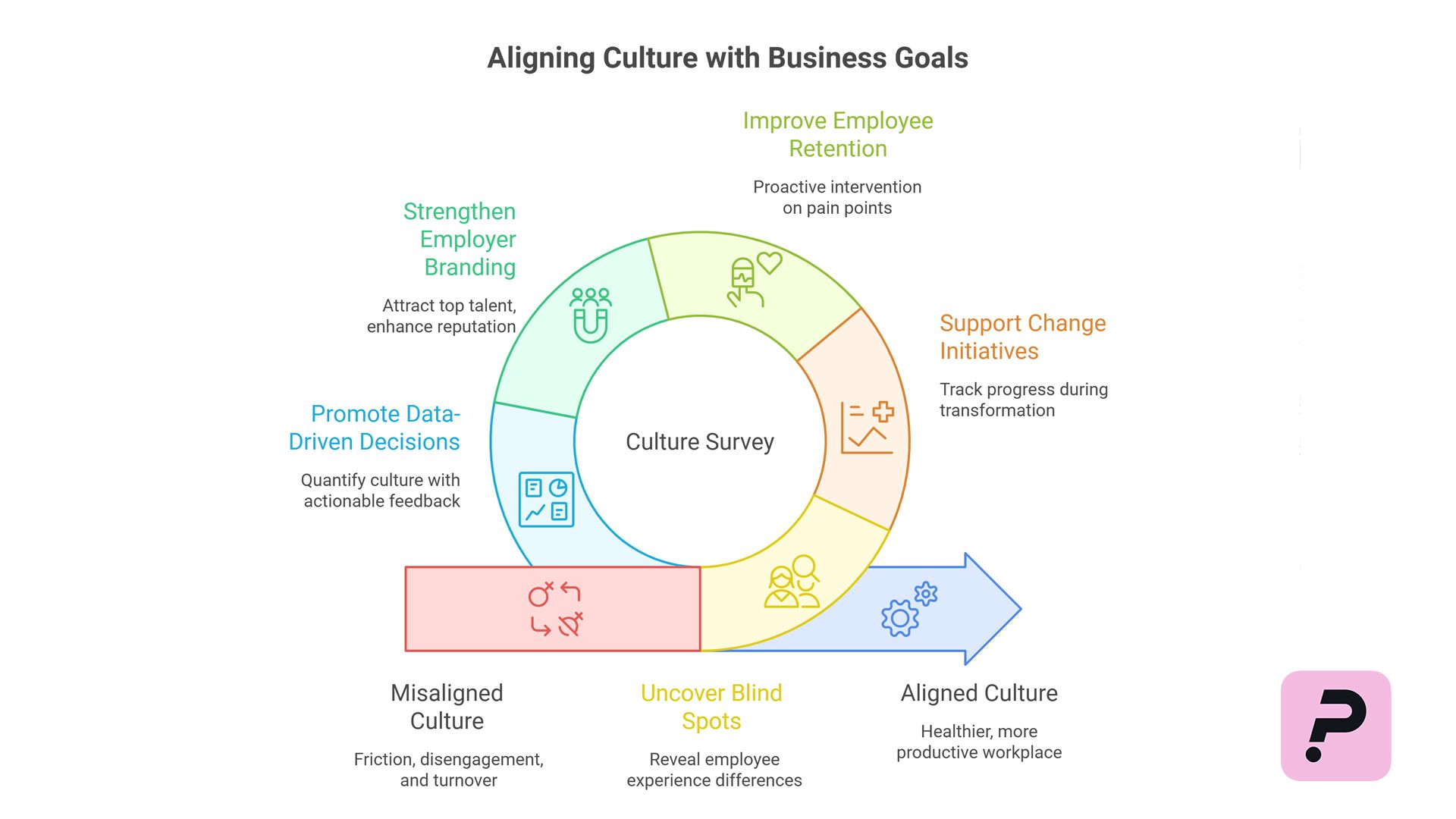
Here’s why it matters:
-
Uncovers blind spots: What leaders believe about the culture often differs from how employees experience it.
-
Supports change initiatives: Culture surveys help track progress during periods of transformation, mergers, or restructuring.
-
Improves employee retention: Understanding pain points in communication or leadership styles allows proactive intervention.
-
Strengthens employer branding: A transparent, feedback-driven culture attracts top talent and enhances your reputation.
-
Promotes data-driven decisions: Culture isn’t intangible anymore—quantify it with clear, actionable feedback.
Ultimately, using a culture survey empowers HR and leadership teams to lead with empathy and evidence, not assumptions.
In summary, it's one of the most effective tools to align people with purpose—and create a healthier, more productive workplace.
Key Types of Organizational Culture Surveys
Not all culture surveys are built the same. Depending on your goals and organizational maturity, you may choose different formats or focus areas. Below are some of the most common types:
1. Baseline Culture Surveys
Used to establish a starting point for understanding how employees perceive the overall company culture. Ideal during onboarding or cultural transformation.
2. Leadership Perception Surveys
These assess how employees view the behavior, transparency, and supportiveness of their managers and executive team.
3. Values Alignment Surveys
Focus on whether team members feel that daily operations and decisions align with the company's stated mission and values.
4. Team-Level Culture Surveys
Zoom into specific departments (e.g., sales vs. product) to compare subcultures and identify silos or alignment gaps.
5. Post-Merger Culture Surveys
Designed for organizations undergoing mergers or acquisitions to assess cultural fit, conflict zones, and integration challenges.
Each type plays a unique role in shaping a more cohesive and inclusive organization.
To summarize, the right culture survey depends on your current challenges—whether you’re building, measuring, or transforming workplace culture.
Suggested Questions in an Organizational Culture Survey Template
To get meaningful insights, your questions must be well-structured, unbiased, and aligned with your goals. Below is a sample list of recommended questions grouped by key cultural themes:
| Question | Type | Purpose |
|---|---|---|
| What department do you work in? | Dropdown | To segment data for comparison across teams |
| When was your start date? | Short Text (Date) | To analyze perceptions by tenure |
| How would you rate our company culture? | Opinion Scale | To measure overall sentiment |
| How satisfied are you with your manager's leadership style? | Rating | To evaluate leadership influence |
| Our business goals are driven by… | Multiple Choice (Multi-select) | To understand what employees believe drives decisions |
| Our leadership team is one that… | Multiple Choice (Multi-select) | To gauge perceptions of transparency, support, and inclusion |
| Any other thoughts or suggestions? | Long Text | To gather qualitative feedback and recommendations |
In summary, these core questions provide a balanced mix of quantitative and qualitative data to evaluate your culture from multiple angles.
How to Create Organizational Culture Survey in Porsline (Step-by-Step Guide)
Porsline makes it incredibly easy to build, customize, and deploy a professional organizational culture survey. Follow these steps to get started:
Step 1: Create a New Survey
-
Log in to your Porsline account or create a free account.
-
Click “Create new survey” and choose “From Scratch” or use a prebuilt template from the HR templates section.
Step 2: Add Core Questions
-
Add questions based on the structure in the previous section.
-
Use Likert scales, multiple choice, and open text fields.
-
For better user experience, group questions into logical sections (e.g., Leadership, Values, Communication).
Step 3: Use Smart Logic to Personalize
-
Apply Logic to show relevant questions only to certain departments or roles.
-
Use Skip Logic to guide employees to the most relevant parts of the survey.
-
Add Piping to personalize questions with previous answers (e.g., “As a member of the [Department] team…”).
Step 4: Customize Design
-
Upload your company logo.
-
Choose a clean background and apply your brand colors.
-
Use recommended visual settings:
-
Question color:
#1A1A1A -
Answer highlight:
#0058A6 -
Confirmation color:
#00C897 -
CTA button:
#FF7A59 -
Font: Arvo or Merienda
-
Step 5: Set Distribution Options
-
Share via a secure link or QR code.
-
Embed the survey on your intranet or show it as a popup.
-
Enable anonymous responses for honesty.
Step 6: Analyze Responses
-
Use Porsline's dashboard and real-time charts to filter results by department, tenure, or manager.
-
Export to Excel, CSV, or Google Sheets for advanced analysis.
-
Share summary reports with leadership.
Step 7: Activate Advanced Features (Optional)
Available with Professional/Enterprise Plans:
-
Webhooks and API to connect with Slack, Trello, or your HR system.
-
Voice feedback, file upload, or geolocation tagging if relevant.
-
Restrict submissions or enable scheduling for pulse surveys.
In short, Porsline gives you a smart, flexible, and professional-grade solution to measure culture across your organization—with no coding required.
FAQ About organizational Culture Surveys
1. What is the goal of an organizational culture survey?
To understand how employees perceive the workplace environment, leadership style, values, communication, and team dynamics.
2. How often should we run a organizational culture survey?
At least once a year. Many companies also run shorter “pulse” surveys quarterly to track progress and spot early issues.
3. Should organizational culture surveys be anonymous?
Yes. Anonymity encourages honesty and reduces fear of consequences, especially when addressing leadership or conflict topics.
4. How long should a culture survey be?
Ideally 10–15 questions. Focus on relevance over quantity to avoid survey fatigue.
5. What’s the best way to analyze survey results?
Use filters by department, tenure, or role. Compare scores over time. Look for patterns in open-ended responses and align findings with your strategic goals.


