Lead Generation Survey Template
Ready to fill your pipeline with qualified leads—and spend less time chasing the wrong prospects?
Discover the power of a modern lead generation survey: a smart, interactive template that not only collects rich customer data, but turns every response into a potential sale. With the right questions and seamless integrations, you can fast-track conversions, personalize your approach, and turn data into growth—all in just a few clicks.
In today’s hyper-competitive digital landscape, a generic contact form simply isn’t enough to drive sustainable growth. To turn website visitors into high-quality leads, you need a smarter, more interactive approach.
A lead generation survey doesn’t just collect basic contact details—it asks the right questions to uncover each prospect’s needs, readiness, and potential value. By guiding users through a friendly, step-by-step experience, you get the insights you need to qualify, segment, and convert leads faster—while your prospects enjoy a personalized, frictionless journey.
Imagine you’re a SaaS marketing manager struggling with low conversion rates from landing page visitors. By replacing your old signup form with an engaging, mobile-friendly survey that asks about company size, budget, and challenges, you not only double your response rate but empower your sales team to prioritize and nurture the most promising leads from day one.
This is the difference between capturing contacts—and capturing opportunities.
What Is a Lead Generation Survey?
A lead generation survey is an interactive form designed to capture detailed information from prospects, enabling businesses to qualify and segment leads based on their responses.
Unlike traditional contact forms, these surveys go beyond “name and email”—they include targeted questions about the respondent’s role, business needs, challenges, budget, and purchase timeline. This richer data helps marketing and sales teams:
- Qualify leads: Identify which prospects are a good fit and ready to buy.
- Understand audience needs: Tailor follow-ups and offers to specific pain points.
- Segment efficiently: Group leads by criteria such as industry, company size, or buying intent.
- Improve marketing ROI: Focus campaigns and outreach on the most valuable opportunities.
Modern lead generation surveys are often embedded on landing pages, shared in email campaigns, or used in paid ads—delivering a conversational, mobile-first experience that encourages more users to complete the journey.
A lead generation survey is more than a data collection tool—it’s a strategic asset that empowers you to turn every answer into actionable business growth.
Why Use a Lead Generation Survey?
In a world where attention spans are shrinking and competition is intensifying, relying on gut feeling or “spray-and-pray” campaigns is a fast track to wasted budget and missed opportunities. A lead generation survey empowers your team to work smarter, not harder—by focusing on the prospects most likely to convert, and by delivering a tailored customer experience from the very first touchpoint.
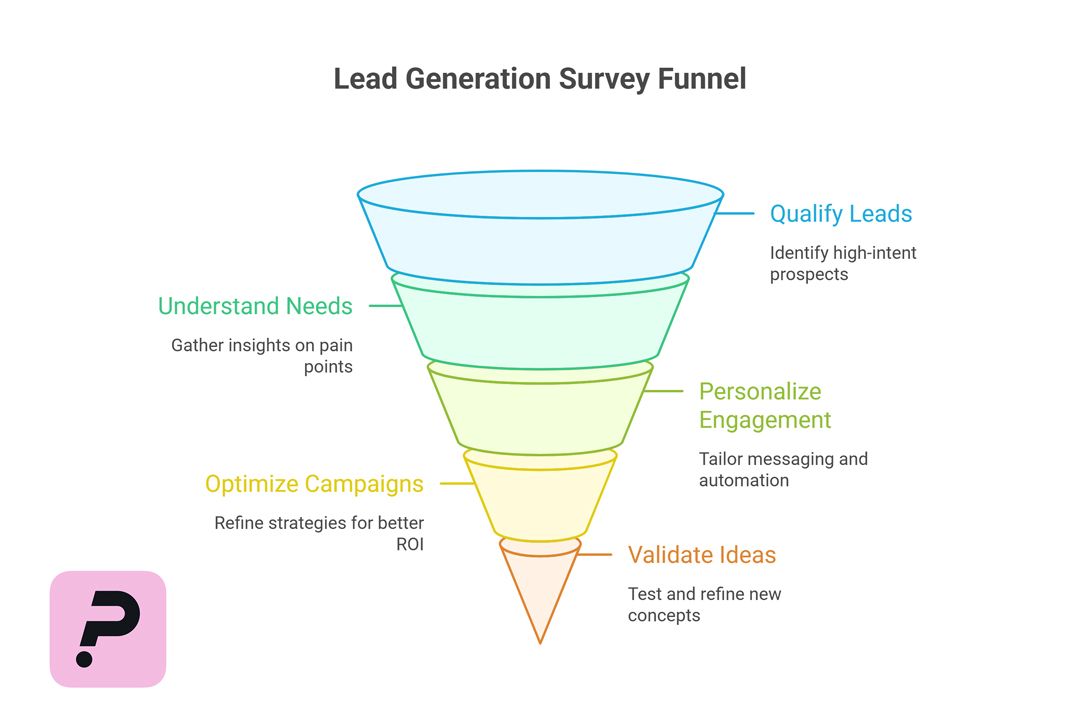
Key Business Benefits:
1. Qualify and Prioritize the Right Leads
Lead generation surveys let you quickly identify high-intent prospects by asking qualifying questions up front (e.g., budget, business size, timeline). This helps sales teams spend their energy where it counts—closing deals, not chasing dead ends.
2. Deeply Understand Customer Needs
Collect valuable insights about each prospect’s pain points, objectives, and decision criteria. This data powers smarter segmentation, more relevant messaging, and higher engagement throughout the funnel.
3. Power Personalization and Automation
Survey responses can be used to automatically segment leads and trigger personalized nurturing flows in your CRM or marketing automation platform—making follow-up timely and relevant.
4. Optimize Campaign Performance and ROI
With richer audience data, you can A/B test messages, refine your offers, and continuously improve conversion rates—all while lowering customer acquisition costs.
5. Validate Product-Market Fit and New Ideas
Use surveys to gather direct feedback on new products or services, measure market interest, and shape your roadmap with confidence.
A recent study found that organizations using interactive lead qualification forms increased their conversion rates by over 40% compared to those using static forms or basic contact pages.
A modern lead generation survey is not just a form—it’s your competitive edge for smarter marketing, better sales targeting, and measurable business impact.
Try Porsline’s Lead Generation Survey Templates
Types of Lead Generation Surveys (with Practical Examples)
Lead generation surveys are not one-size-fits-all. The most effective teams deploy different survey types at each stage of the funnel or for specific business objectives. Here are the most impactful formats, plus real-world use-cases:
1. Initial Lead Qualification Survey
Purpose: Collect essential details like name, company, contact info, and interest area.
Example: An interactive form on your landing page offers a free eBook or demo. Visitors share their business type and key challenges in exchange.
2. Advanced Lead Qualification Survey
Purpose: Go deeper to assess budget, decision timeline, and buying readiness.
Example: Before a discovery call, prospects complete a short survey about their budget range, current solutions, and decision process—helping sales prioritize follow-up.
3. Audience Segmentation Survey
Purpose: Group leads by industry, company size, or pain points to deliver tailored messaging.
Example: An automated survey in an email campaign routes HR professionals to one follow-up path, and marketing agencies to another, based on their responses.
4. Product Validation or Feedback Survey
Purpose: Collect targeted feedback on new features or products before full launch.
Example: SaaS companies email a quick survey to beta users, asking which features would convince them to upgrade.
5. Post-Event or Post-Campaign Survey
Purpose: Capture fresh leads after a webinar, conference, or digital campaign.
Example: After a virtual event, attendees fill out a survey on what topics or services they’d like to learn about next, qualifying themselves for specific nurture tracks.
Choosing the right survey format for your funnel stage and business goal ensures higher engagement and richer data—powering a seamless handoff from marketing to sales.
Recommended Questions for a Lead Generation Survey
| Question | Question Type | Purpose/Value |
|---|---|---|
| What’s your full name? | Short Text | Personalization, follow-up |
| What’s your company/organization name? | Short Text | Lead context, B2B targeting |
| What’s your business email address? | Short Text | Contact, validation |
| Best phone number to reach you? | Short Text | Direct sales outreach |
| What industry do you operate in? | Dropdown / Multiple Choice | Segmentation, tailored follow-up |
| How many employees are in your organization? | Multiple Choice | Prioritization, solution fit |
| What challenges are you currently facing? | Multi-Select | Pain points, personalized solutioning |
| What’s your estimated budget for this project/solution? | Multiple Choice | Lead qualification, sales forecasting |
| Preferred communication channel? | Multiple Choice | Experience personalization |
| Are you interested in a free trial or consultation? | Yes / No | Lead readiness, sales trigger |
| What’s your decision timeline? | Multiple Choice | Lead scoring, urgency |
| Would you like to receive exclusive updates/offers? | Yes / No | Email list growth, nurturing campaigns |
How to Design a Lead Generation Survey on Porsline – Step-by-Step
Designing a lead generation survey is no longer just about collecting data—it’s a strategic tool to build a rich database that empowers you to make precise decisions and direct sales resources efficiently. Here’s a complete methodology to create an advanced survey using Porsline:
1. Choose the Right Template and Set Up the Basics
Sign up for Porsline, then select the “Lead Generation” template from the Porsline templates library, or create a new survey tailored to your brand.
Customize a professional welcome page that explains the purpose and value to participants:

“Help us serve you better by answering the following questions, so we can provide you with a personalized offer and have our team contact you in record time.”
2. Build the Core Question Structure
Start with primary qualification questions (name, email, phone number) and include clarifying text for each question to build trust and reassure participants about data privacy.
Add a key question:
“What type of services are you looking for?”
(e.g., Contracts – Real Estate – Taxes – Human Resources)
Include a question on the preferred support plan (monthly subscription – on-demand) with helpful guidance:
“We can customize an offer that perfectly matches your requirements.”
3. Enable Logic
Leverage smart customization in your survey through the following scenarios:
A) Service-based question flow:
-
If “Real Estate” is selected → Show extra questions about property type (residential, commercial, land, other) with a text field for “Other.”
-
If “Taxes” is selected → Show a question about tax service type (filing, consulting, audit, other).
-
If multiple services are chosen → Ask: “Would you prefer a bundled package covering all requested services?” If “Yes,” display a confirmation message that a tailored offer will be prepared.
B) Support plan-based questions:
-
Monthly subscription → Ask about the number of employees or targeted projects.
-
On-demand → Ask about urgency level or task type, with a detailed text field if “urgent request” is chosen.
C) Lead readiness assessment:
Dynamic question: “When would you like to start working with us?” (Within a week – Within a month – Later)If “Within a week” is selected → Show an immediate message stating their request will be prioritized.
D) Data quality assurance:
Require email and phone number before allowing form submission.4. Add a Lead Scoring System
In today’s competitive business environment, random data collection isn’t enough—you need an intelligent mechanism to measure a lead’s seriousness and readiness to buy. Lead scoring in Porsline surveys allows you to rank prospects based on their responses and focus your marketing and sales efforts on the most valuable segments.
How it works:
-
Assign point values to each answer to reflect the lead’s fit for your product/service.
-
Automatically calculate the total score at the end to classify leads (High, Medium, Low).
-
Trigger the appropriate follow-up, such as sending the lead to the sales team or adding them to a nurturing campaign.
Example:
-
Question: “What is your expected purchase timeframe?”
-
Within a week → 30 points
-
Within a month → 20 points
-
In 3+ months → 10 points
-
-
Question: “What is your budget range?”
-
Over $20,000 → 30 points
-
$5,000–$20,000 → 20 points
-
Under $5,000 → 10 points
-
With this system, leads with higher budgets and shorter decision timelines will score the highest, giving them top priority in follow-up.
Key Benefits for Businesses:
-
Improved targeting accuracy – Identify high-value leads clearly.
-
Faster follow-up – Engage ready-to-buy leads immediately.
-
Higher conversion rates – Deliver the right offer to the right audience.
-
Time and resource savings – Minimize effort on unqualified leads.
You can learn how to add lead scoring to your surveys in Porsline by watching this tutorial: How to add score to your online survey?.
5. Design a Modern UI & UX
Apply your brand colors, logo, and modern fonts (e.g., Tajawal or Cairo).
Add a custom thank-you page confirming quick follow-up and include a strong CTA button for further exploration or sharing.
6. Enable Smart CRM Integrations & Analyze Results
Once data is collected, the next step is converting leads into actual sales opportunities. Porsline offers advanced integrations and analytics to save time, reduce manual errors, and boost your sales team’s speed.
A) CRM Integration:
Porsline supports direct integration via Webhook/API or through Zapier with popular CRMs like Salesforce, HubSpot, and Zoho, enabling:Automatically send qualified leads to your CRM once they meet specific criteria, such as exceeding a certain lead score (e.g., 80/100).
-
Include full survey responses in each lead’s CRM profile, enabling your sales team to start conversations based on the lead’s actual needs.
-
Trigger automated workflows within the CRM, such as sending personalized offers or scheduling direct sales calls.
Example:
If a lead scores over 70 points in the survey:
-
They are automatically added to the “High-Priority Leads” list in Salesforce.
-
A follow-up task is automatically assigned to the responsible sales representative.
-
A welcome email containing a special offer is sent based on their answers.
B) Email Marketing and Campaign Integration:
Alongside CRM tools, you can integrate Porsline with email marketing platforms like Mailchimp, ActiveCampaign, or Sendinblue to: Launch targeted nurturing campaigns for leads who are not yet ready to buy, sending them educational content or gradual offers until they reach a purchase-ready stage.
C) Instant Sales Notifications:
The key to closing deals quickly lies in rapid response. With Porsline, you can:
-
Set up instant email or SMS alerts to sales reps whenever a high-value lead responds.
-
Customize notifications to include lead details such as name, contact information, and score summary—allowing immediate outreach without opening the dashboard.
-
Use Webhook to send lead data directly to any internal system in real-time.
D) Advanced Survey Analytics in Porsline Dashboard
The Porsline dashboard is more than just a results display—it’s a full analytics platform that allows you to:-
Monitor completion rates: Track the percentage of participants who start versus those who finish the survey.
-
Compare performance over time: Review lead score trends weekly or monthly to evaluate campaign effectiveness.
E) Strategic Optimization Based on Insights
Once the data is analyzed, focus on continuous improvement:-
Adjust point distribution if current scoring criteria don’t accurately reflect actual lead quality.
-
Test alternative question formats to increase the number of qualified leads.
-
Integrate Porsline with Google Analytics and Meta Pixel via Google Tag Manager to link survey data with on-site behavior.
-
Use these insights to refine paid ad targeting and increase the proportion of qualified leads generated from ad campaigns.
By combining smart CRM and email integrations with continuous analysis through the Porsline dashboard, you can build a fully automated cycle—from data collection and qualification to rapid follow-up with your most valuable prospects—maximizing both closing rates and ROI.
7. Privacy & Compliance
Add a short privacy policy at the end of the survey with a link to full terms. Limit participation frequency per user and hide unnecessary fields to protect lead privacy.
By following these steps and leveraging Porsline’s intelligent features—such as conditional logic, lead scoring, and smart integrations with CRM and email marketing platforms—you can transform every survey response into a concrete action that boosts your closing rates and maximizes ROI.
Whether through personalized question flows, advanced scoring systems, or seamless integrations, you ensure that every answer moves you closer to a successful deal and more impactful business outcomes.
Start building your first Lead Generation Survey on Porsline today and turn your data into precise decisions and measurable results.
For more details about Porsline’s smart form-building features, you can read the Porsline Account Features Guide or visit our Help Center to access tutorial videos and live support.
1. What is a lead generation survey?
A lead generation survey is an interactive form that collects detailed information from prospects to help you qualify and segment leads. Unlike basic contact forms, it asks targeted questions about business needs, budget, and buying intent—so your team can focus on the right opportunities.
2. What are the most important questions to include?
Start with contact details (name, email, phone), then ask about company size, industry, pain points, budget, and purchase timeline. These questions help you prioritize leads and personalize your follow-up.
3. Can I use a free lead generation survey template with Porsline?
Yes, Porsline offers ready-made templates that you can use for free or customize for your unique needs—no coding required.
4. How do I increase completion rates for my lead capture form?
Keep your survey short and relevant, use one question per page, and activate conditional logic so users only see questions that matter to them. Branded design and mobile optimization also boost response rates.
5. Can I connect my survey to my CRM or email marketing tools?
Absolutely! Porsline supports integrations with major CRM and marketing platforms like HubSpot, Salesforce, and Mailchimp, so you can automate lead tracking and nurturing.


