Product-Market Fit Survey Template
Is your product solving a real problem for a real audience?
A product-market fit survey is your smartest tool to find out — fast, accurately, and with actionable insights.
In today’s competitive market, launching a great product isn’t enough. Without product-market fit, even the most beautifully designed and well-funded products fail. That’s because users don’t adopt products they don’t need, and companies can’t grow on assumptions.
Product-market fit (PMF) is that golden moment when your product solves a real problem for a clearly defined audience — and they’re willing to pay, recommend, and come back for more. It’s the difference between “just another tool” and “I can’t live without it.”
But how do you know if you've reached it? That’s where a Product-Market Fit Survey comes in. It’s the most reliable way to validate your product’s value — directly from the people using it.
In this article, you’ll learn:
-
What a PMF survey is (and what it’s not)
-
Why it’s essential for sustainable growth
-
What questions to include
-
How to build and analyze your survey using Porsline
-
How to act on the data to improve your product
What Is a Product-Market Fit Survey?
A Product-Market Fit Survey is a focused feedback tool designed to evaluate whether your product truly meets the needs of its users. Unlike general customer satisfaction surveys, PMF surveys measure something deeper: the emotional and functional connection between your users and your product.
The core idea comes from Sean Ellis, the growth expert behind Dropbox and Eventbrite, who proposed a simple but powerful question:

How would you feel if you could no longer use our product?"
If 40% or more of users respond with "Very disappointed", you’re likely on the path to product-market fit.
But a true PMF survey goes beyond a single question. It digs into:
-
How frequently users engage with your product
-
What they value most
-
Whether they’ve recommended it to others
-
What they think needs improvement
-
Who they are demographically
This isn’t about vanity metrics. It’s about uncovering truths that drive retention, advocacy, and sustainable growth.
Why This Product-Market Fit Survey Matters for Scalable Growth
Startups often move fast, experiment often, and pivot when needed — but without a clear understanding of whether their product actually fits the market, they’re flying blind.
A Product-Market Fit Survey is more than a data collection tool. It’s a growth compass.
Here’s why this survey is critical for sustainable, data-informed growth:
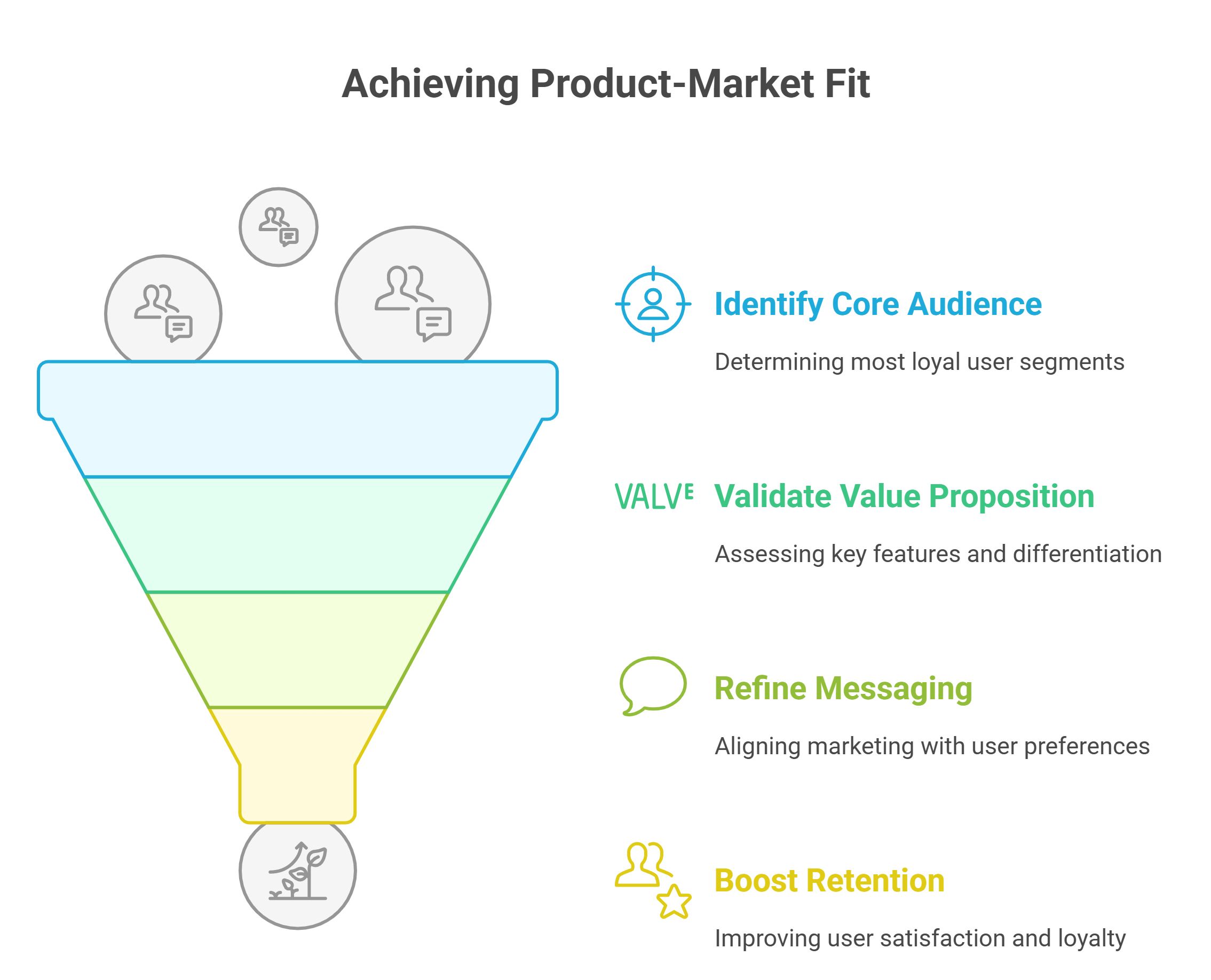
1. It removes guesswork from product decisions
Instead of relying on gut feelings or team debates, you collect feedback directly from active users. You learn what matters to them, not what you assume is important.
2. It helps you identify your most loyal user segments
By analyzing which users are most disappointed at the thought of losing access to your product, you gain clarity on who your core audience is — and who to double down on.
3. It validates your value proposition
If users consistently highlight the same feature as the most valuable, you’ve got a strong indicator of product differentiation. If they don’t… well, that’s equally valuable information.
4. It supports smarter messaging and positioning
Once you know what your users actually love, you can mirror their language in your marketing. This alignment improves conversions and brand trust.
5. It minimizes churn and boosts retention
When users feel heard — and when their feedback leads to meaningful improvements — they stay longer. Your PMF survey helps you catch weak spots before they become churn reasons.
In short, this survey bridges the gap between what your team builds and what your users actually need. And that’s what powers long-term growth.
Essential Questions to Include in a Product-Market Fit Survey
A strong product-market fit survey isn’t long — but it’s precise. Every question should uncover either emotional commitment, practical value, or strategic insights to help you build a better product and growth strategy.
Here are the essential questions you should include, organized by their purpose:
Key Survey Questions
| Question | Type | Purpose |
|---|---|---|
| How often do you use our product? | Multiple choice (frequency scale) | Understand usage patterns to segment users by engagement level |
| How would you feel if you could no longer use our product? | Likert scale (Sean Ellis question) | Determine PMF score – core emotional dependency |
| Have you recommended us to a friend or colleague? | Yes/No | Measure advocacy and product satisfaction |
| What do you think sets us apart from the competition? | Open-ended | Identify unique value propositions from the user’s perspective |
| What areas could we improve? | Multiple choice + optional comment | Discover friction points and guide product improvements |
| What is your current employment status? | Dropdown | Segment users by professional context |
| How do you identify? (Optional) | Dropdown | Enable inclusive demographic filtering |
Best Practices:
-
Keep the survey short (6–8 questions max)
-
Mix quantitative and qualitative questions
-
Use conditional logic to keep the experience smooth (e.g., show follow-up if answer is negative)
-
Make some questions optional — especially demographic ones — to respect user privacy
This balanced structure helps you answer the big question:
“Is our product solving the right problem for the right people — in the right way?”
And once you’ve got those answers, the real growth begins.
How to Create a Product-Market Fit Survey Using Porsline
Creating a product-market fit survey shouldn't require a developer, weeks of planning, or complicated tools. With Porsline, you can launch a professional, fully customizable PMF survey in just a few clicks — and gather high-impact insights that drive smarter product decisions.
Here’s how to do it the right way:
Step 1: Choose a Purpose-Built Template
Start by logging into your Porsline dashboard.
Select “Create New Survey”, then choose the Product-Market Fit Survey Template — specifically designed to help startups and product teams capture the right data.
Prefer to build from scratch? No problem. You can add the exact questions, logic, and design elements that fit your product and audience.
Step 2: Add the Core Questions That Uncover Real Value
Your PMF survey should include a mix of quantitative and qualitative questions — not too many, but enough to surface true insights.
Essential questions to include:
-
Usage frequency (e.g., daily, weekly, monthly)
-
The Sean Ellis question: “How would you feel if you could no longer use our product?”
-
Referral intent: “Have you recommended us to others?”
-
Open-ended value feedback: “What do you find most valuable about our product?”
-
Improvement suggestions
-
Demographic profiling: industry, role, company size
Each question is fully customizable, and you can adjust the language, labels, or formats to match your brand voice and audience.
Step 3: Apply Conditional Logic to Personalize the Experience
Use Porsline’s powerful logic engine to make your survey smarter — and shorter for each user.
For example:
-
If a respondent selects “Not disappointed” to the Sean Ellis question, show a follow-up like:
“What could we improve to make our product more valuable to you?”
This ensures that each participant only sees questions that are relevant to them, improving completion rates and the quality of responses.
Step 4: Add Scoring to Measure Product-Market Fit Intelligently
Porsline lets you assign custom point values to each answer, turning subjective responses into measurable product-fit scores.
For example:
-
“Very disappointed” = 10 points
-
“Somewhat disappointed” = 5
-
“Neutral” = 0
You can then calculate a total score for each respondent and segment your results accordingly. This feature is ideal for identifying your most loyal, high-retention users — and tracking progress over time.
Even better? You can use score-based logic to show custom thank-you pages or send targeted follow-ups based on each user's score.
Step 5: Customize the Look and Feel to Match Your Brand
First impressions matter — even in surveys.
With Porsline, you can visually tailor the survey interface by:
-
Setting a clean background (
#F9FAFB) for clarity -
Using branded primary colors like
#1D4ED8(deep blue) for CTA buttons -
Uploading your logo
-
Choosing modern, legible fonts like Inter, GE SS Unique, or Cairo (for Arabic)
You can also customize the welcome and thank-you pages to align with your tone and leave a lasting impression.
Step 6: Analyze Results in Real Time — with Smart Alerts
Once responses start coming in, Porsline turns your data into visual dashboards — no spreadsheets required.
But that’s not all:
You can set up real-time email notifications to alert your product or CX team whenever:
-
A user leaves a low satisfaction score
-
A high-value segment responds
-
A critical improvement suggestion is submitted
This ensures you never miss a signal — and can act on feedback instantly.
With Porsline, running a PMF survey becomes more than just a data collection task — it becomes a real-time growth engine that helps you validate your product, refine your roadmap, and deepen customer relationships.
FAQ about Product-Market Fit Survey
1. What is a product-market fit survey?
A product-market fit survey is a structured questionnaire designed to evaluate how well a product solves a real problem for a defined group of users. It helps you measure emotional attachment, perceived value, and user satisfaction — all essential indicators of product-market fit.
2. When should I run a product-market fit survey?
You should run a PMF survey after launching your MVP, during early traction, or before scaling. It’s especially useful when churn increases, engagement drops, or you're preparing for a major product or market shift.
3. What is a good product-market fit score?
According to the Sean Ellis benchmark, if 40% or more of your respondents say they would be “very disappointed” if they could no longer use your product, you’re likely in product-market fit territory.
4. How many responses do I need for accurate results?
Aim for at least 40–100 qualified responses from active users. Quality matters more than quantity. Segmenting by role or industry can also increase accuracy.
5. Can I use Porsline to create a product-market fit survey?
Absolutely. Porsline offers a purpose-built Product-Market Fit Survey Template, advanced logic features, answer scoring, and real-time dashboards — making it one of the best no-code tools to validate PMF quickly and effectively.
6. How is a product-market fit survey different from a customer satisfaction survey?
A PMF survey focuses on need, emotional attachment, and strategic product alignment, while customer satisfaction surveys measure overall experience or service quality. PMF surveys are used earlier in the product lifecycle to guide growth decisions.
7. Can I automate follow-ups based on survey responses?
Yes. With Porsline, you can create logic-based workflows, assign scores to responses, and trigger email alerts or redirect users to different thank-you pages based on how they answer — all without writing any code.


