


When employees feel disconnected, undervalued, or stuck in poor working conditions, it shows up in your numbers long before it shows up in an exit interview. Turnover climbs. Productivity drops. And by the time you notice, the damage is already done.
Most companies care about employee satisfaction. The real problem is that they aren't measuring it in a way that tells them anything useful. A once-a-year paper survey, suggestion boxes in the breakroom, or an informal pulse check during one-on-one meetings gives you a snapshot, not a strategy.
The right employee satisfaction measurement tools change that. They give you the actionable insights to improve employee satisfaction, support employee wellbeing, and build the kind of organizational culture where people actually want to stay.
This guide covers what to measure, what features to look for, and which tools stand out in 2026.
In 2026, the best tools do more than collect answers. They help HR teams move faster by turning prompts, existing Word documents, Excel-based question banks, and ready-made templates into structured employee surveys that can be reviewed, customized, shared, and analyzed in one workflow.
How to Measure Employee Satisfaction (Key Metrics Explained)
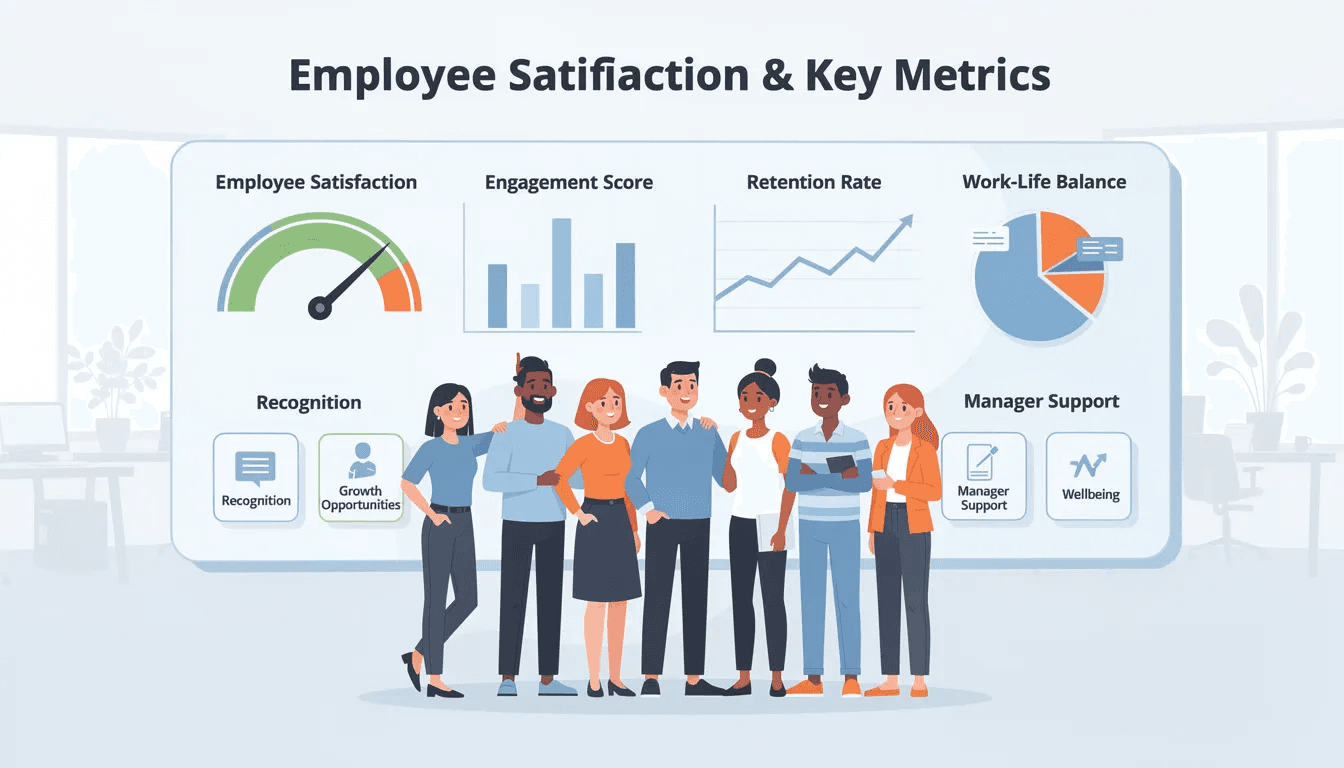
Before picking a tool, you need to know what you're actually trying to measure. Employee satisfaction isn't a single number. It's a combination of how people experience their job and work environment across multiple dimensions. Here are the key metrics to understand.
Employee Satisfaction Index (ESI)
The employee satisfaction index measures overall job satisfaction across three dimensions:
- How satisfied employees are with their workplace
- How well it meets their expectations
- How close it comes to their ideal job
Responses produce a final number on a scale from 0 to 100. Based on published employee satisfaction ratings across industries, a score above 70 is generally healthy. A score below 50 is a signal that something needs attention.
Employee Net Promoter Score (eNPS)
The net promoter score eNPS comes down to one question: "How likely are you to recommend this company as a place to work?" on a scale of 0 to 10.
Anyone who scores 9 or 10 falls into the Promoter category, 7 or 8 makes someone a Passive, and anything below 7 marks them as a Detractor.
Your final eNPS is the difference between the share of Promoters and the share of Detractors. It's one of the clearest signals of employee loyalty you can collect in under a minute.
Pair it with an open-ended follow-up to understand the reason behind the score.
Pulse surveys
Pulse surveys are short, frequent check-ins, usually 3 to 10 questions, sent weekly or monthly. Unlike traditional annual surveys, they let you catch problems early and identify trends before they affect retention.
The best tools deliver results in real time and allow anonymous feedback.
Absenteeism and turnover rates
Not all employee satisfaction metrics come from surveys. A spike in absences or a rise in voluntary departures is often the first signal of poor employee satisfaction, well before any survey would catch it.
It can also mean that real-time feedback isn't being acted on. When employees share concerns and nothing changes, disengagement follows.
Work-life balance issues, poor workplace morale, and team conflict all tend to show up in attendance and attrition before they surface in a survey report.
Which metrics to combine
No single metric tells the whole story.
The most effective approach combines ESI for baseline tracking, eNPS for loyalty, pulse surveys for ongoing monitoring, and behavioral signals, such as employee turnover rate and absenteeism, as early warning indicators.
Layering in employee engagement surveys and employee engagement metrics, like manager effectiveness, helps fill in the remaining gaps. Some organizations also use focus groups to complement survey data with richer qualitative conversations.
Pairing quantitative scores with qualitative data from open-ended responses gives you comprehensive feedback that makes it much easier to address concerns at their root.
The goal is reliable data you can act on, not just numbers to report upward.
Why You Need Employee Satisfaction Measurement Tools
Many organizations start with whatever is cheapest and most available: email surveys, Google Forms, shared spreadsheets. It works for a while, then it doesn't. Here's why dedicated tools matter.
- Spreadsheets and email surveys don't scale. Managing survey responses manually becomes a full-time job fast. Dedicated employee survey tools handle distribution, collection, and scoring automatically.
- Anonymity is critical for honest feedback. Employees won't tell you the truth if they think their name is attached to the answer. Proper platforms have anonymity controls built in from the start.
- Manual scoring wastes HR's time. Calculating an employee satisfaction score by hand and formatting reports in a spreadsheet takes hours. Automated platforms do it instantly.
- Insights arrive too late without real-time analytics. Real-time feedback dashboards let you act while there's still time, especially on fast-moving issues.
- Segmenting data by department, role, or tenure matters. Company-wide scores can hide serious pockets of poor employee satisfaction. You need the precision to identify trends where they actually are.
- Free tools like Google Forms lack the features you need. There's no built-in scoring, no anonymity controls, no automated reminders, and no segmentation.
- Compliance and data security can't be an afterthought. Employees share sensitive opinions through these surveys. The tools you use need to meet proper privacy and data protection standards.
Organizations with strong workplace culture and company culture don't get there by accident. They measure regularly, address concerns quickly, and improve employee satisfaction systematically.
The right platform turns employee feedback into data-driven decisions instead of a pile of spreadsheets nobody reads.
What to Look For in Employee Satisfaction Measurement Tools
The right features depend on your organization's size and goals. Here's what actually matters when you're evaluating options.
| Feature | Why It Matters |
|---|---|
| Survey templates (ESI, eNPS, pulse) | Saves setup time with pre-built, validated question sets |
| AI survey creation | Helps HR teams create a first draft from a prompt instead of starting from a blank form |
| Advanced question types | Captures richer data through rating scales, matrix questions, and open text |
| Calculated variables and scoring | Automates ESI and eNPS calculations without manual work |
| Survey logic and branching | Shows each employee only the questions relevant to them |
| Anonymity with access control | Encourages honest feedback while protecting individual privacy |
| Real-time analytics and dashboards | Surfaces problems early so you can act before they escalate |
| Departmental report slicing | Reveals where satisfaction issues are concentrated |
| Automated notifications and reminders | Improves participation without manual follow-up |
| Multilingual support | Ensures all employees can respond in their preferred language |
| Integrations | Connects survey data to your existing HR and communication tools |
| Unlimited responses | Removes caps that limit how much data you can collect |
| Data export and sharing | Makes it easy to report to leadership and act on results |
The best tools make regular feedback easy for employees and make team satisfaction visible to managers, without adding noise to either group's day. Use this list to match features to your priorities, then shortlist accordingly.
Best Employee Satisfaction Measurement Tools at a Glance
| Tool | Best For | Key Features | Free Plan | Starting Price |
|---|---|---|---|---|
| Porsline | Custom scoring, survey logic, multilingual teams | AI survey creation, Word/Excel import, ESI/eNPS scoring, branching logic, 25+ question types, 60+ languages | Yes (100 responses/month) | €23/month (Pro) |
| Workleap | Continuous feedback and engagement for SMBs | Pulse surveys, eNPS, peer recognition, anonymous feedback, AI reporting | No | $5/user/month (Officevibe) |
| TINYpulse | Simple anonymous pulse feedback | Weekly surveys, anonymous two-way messaging, peer recognition, suggestions | No | Custom pricing |
| 15Five | Performance-integrated satisfaction tracking | Engagement surveys, OKRs, 360° feedback, 1-on-1s, peer recognition | No | $4/user/month (Engage) |
| Engagesoft | AI-powered analytics with action planning | Science-backed surveys, heatmaps, AI diagnostics, lifecycle tracking | No | Custom pricing |
Best Employee Satisfaction Measurement Tools in 2026
Each of these tools approaches employee satisfaction measurement differently.
Some prioritize employee recognition and employee happiness, while others focus on engagement levels or performance alignment.
Here's a quick summary of why each one made the list.
- Porsline: The most flexible option for building fully customized employee satisfaction surveys with built-in scoring, advanced logic, and multilingual support. Start a free trial now.
- Workleap: A well-rounded employee experience platform that combines pulse surveys, peer recognition, and performance tools in one place.
- TINYpulse: The go-to for teams that want simple, anonymous weekly feedback without the complexity.
- 15Five: Strong for teams that want satisfaction data integrated directly into performance management.
- Engagesoft: A solid pick for HR teams that need AI-powered analytics and structured action planning.
Read on for the full breakdown of features and pricing for each tool.
Porsline
Porsline is an employee survey platform built to support every stage of the employee journey, from pre-hiring and onboarding through to performance evaluation and exit interviews. HR teams can create any type of employee survey quickly, share it with staff, and get results without needing technical help.
For HR teams that already have internal survey documents, competency frameworks, or performance review forms, Porsline also reduces setup time. You can create an initial survey draft with AI, import questions from a Word or Excel file, use a ready-made HR template, or start from scratch form when you need full control.
What makes it stand out is the level of control it gives you over the survey experience.
Logic adapts questions based on department or role, scores calculate automatically, and reports can be sliced by team or filtered by any variable you define. It's built to handle the full complexity of HR measurement without adding complexity for the people running it.
Best for
HR teams and employee experience professionals who need a single platform for measuring satisfaction, tracking performance, and running surveys at every stage of the employee lifecycle, without needing a technical specialist to manage it.
Key features
- Full lifecycle survey templates: personality tests, job competency assessments, 360-degree feedback, eNPS, pulse surveys, exit interviews, and more
- AI survey creation from a simple prompt for faster first drafts
- Survey logic and branching based on department, role, or any other variable
- Automatic scoring for job satisfaction index, eNPS, and post-training evaluation grades
- Custom variables and formulas for complex, multi-metric calculations
- File upload question type for CVs, documents, and certificates
- Access control via personnel ID codes, with anonymity still guaranteed
- Automatic employee categorization and ranking based on performance scores and competencies
- Unique response links to ensure each survey is completed only once per person
- Graphical reports with advanced filters to slice data by team or department
- API integration with ATS software, Google Sheets, and other tools
Pricing
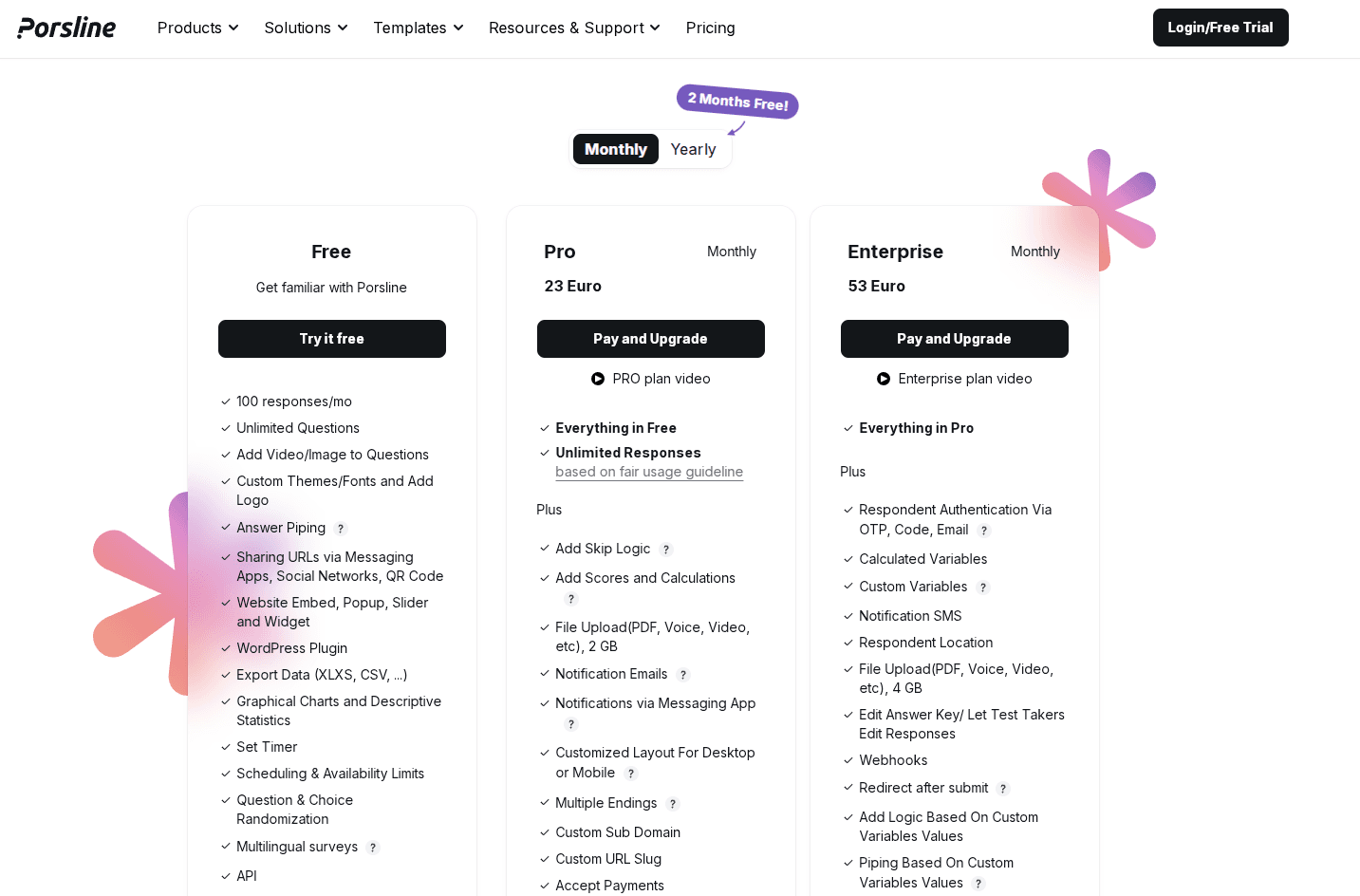
- Free plan: Unlimited surveys and questions, up to 100 responses/month, core features included
- Pro: €23/month, covering unlimited responses, advanced logic, file uploads, and automated notifications
- Enterprise: €53/month, offering stronger access controls, team collaboration, and automation for high-volume programs
Start a free trial and build your first employee satisfaction survey today.
Workleap
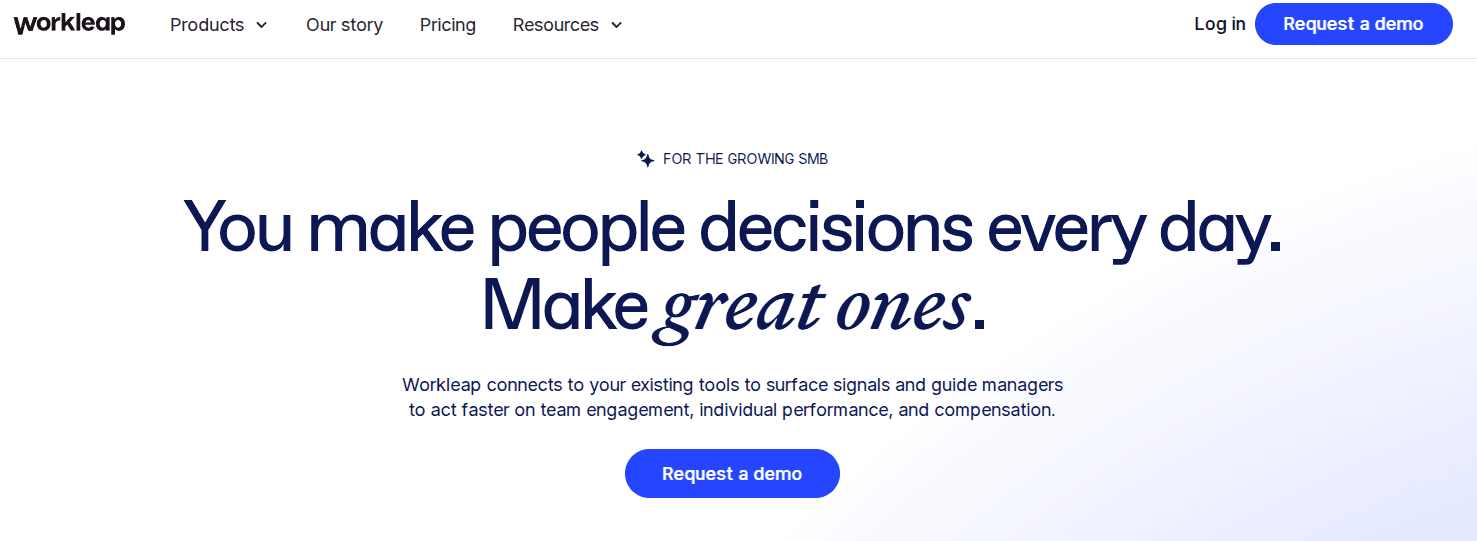
Workleap, built around its Officevibe product, is an employee experience platform that makes continuous feedback a natural part of how managers and teams work day to day.
It brings pulse surveys, eNPS, peer recognition, and one-on-one meeting tools together in a single connected system.
Best for
Growing teams that want to move beyond traditional annual surveys, raise employee engagement levels, and improve workplace satisfaction, all without managing multiple disconnected tools.
Key features
- Automated pulse and custom surveys
- Onboarding and DEIB surveys
- Anonymous feedback and two-way anonymous messaging
- Good Vibes peer-to-peer recognition
- eNPS tracking and metric reporting
- AI reporting, analysis, and suggested actions
- Company announcements
- HRIS provisioning
- Integrations with Microsoft 365, Slack, and Google Workspace
Pricing
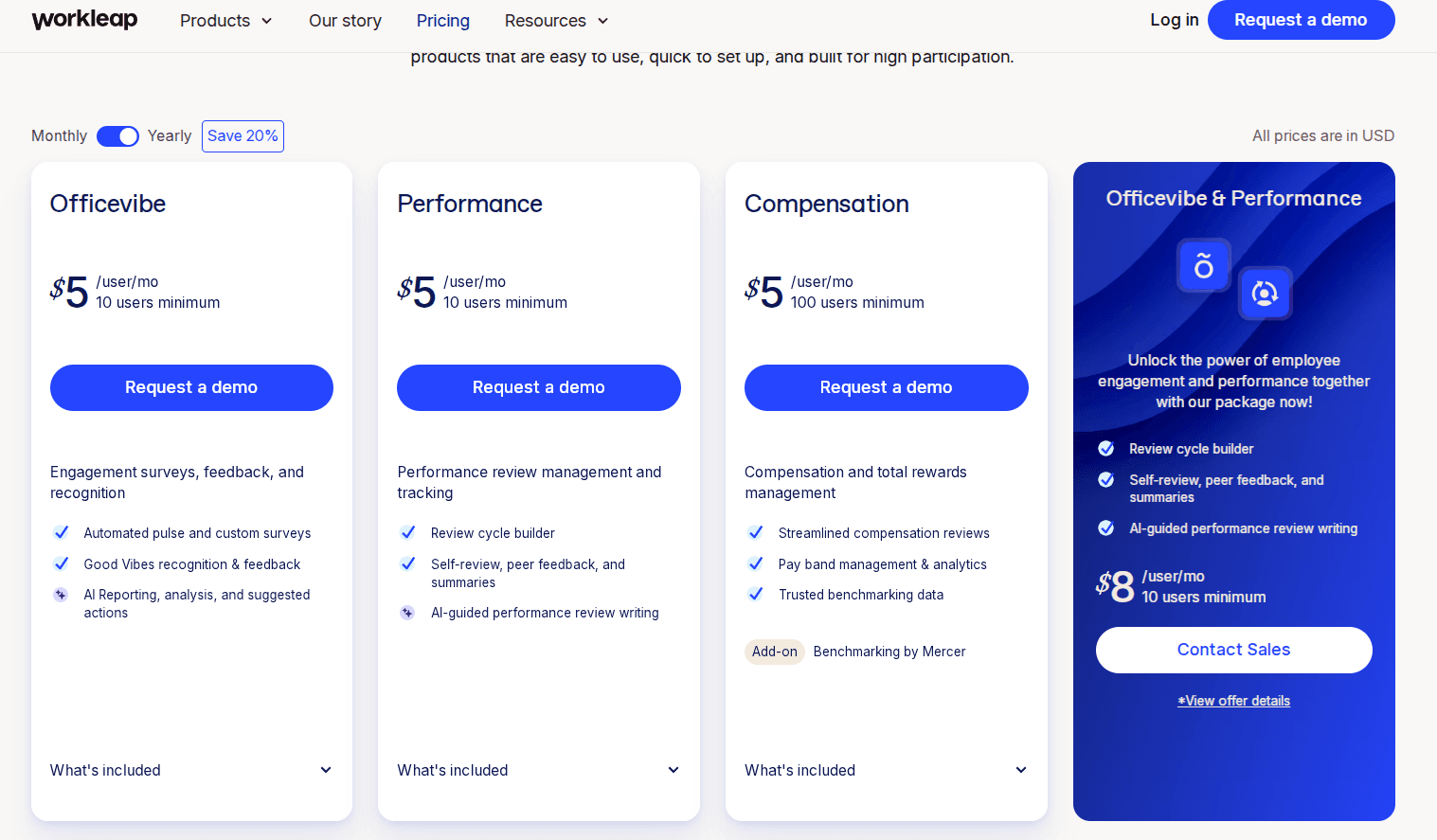
- Free plan: None.
- Officevibe: $5/user/month (billed annually), 10 users minimum, covering engagement surveys, feedback, recognition, and AI reporting
- Performance: $5/user/month (billed annually) for performance review management and tracking
- Officevibe + Performance bundle: $8/user/month (billed annually)
TINYpulse
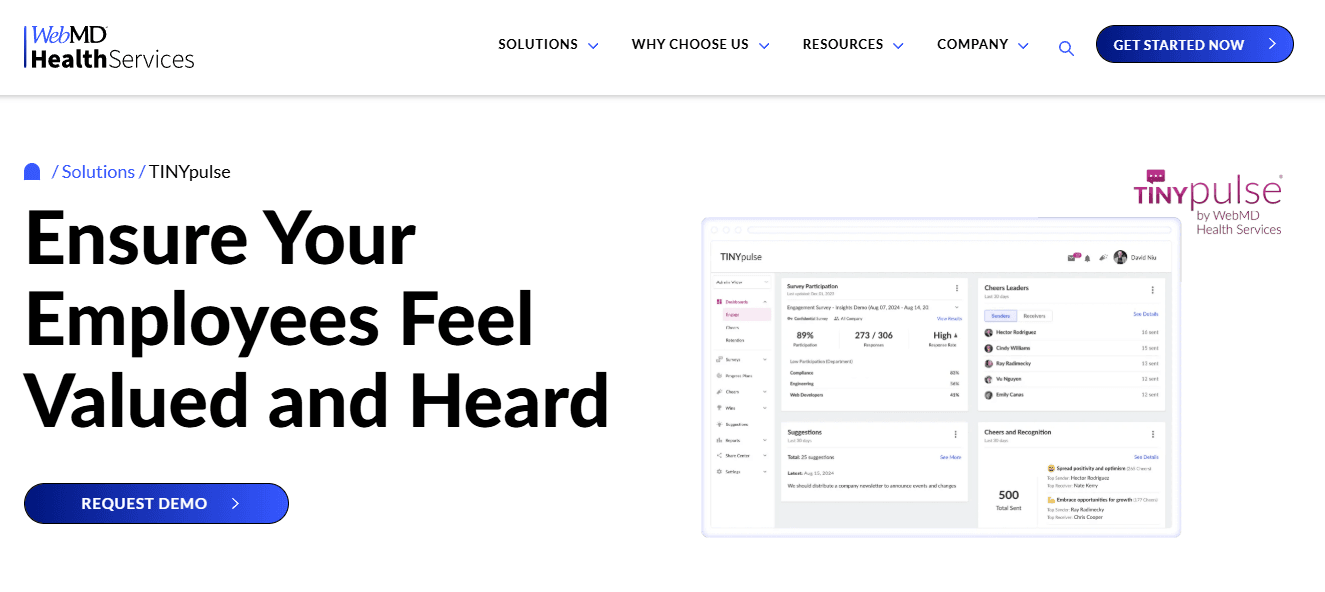
TINYpulse, now part of WebMD Health Services, is one of the most popular pulse survey tools on the market. The core idea is straightforward: send short, anonymous surveys on a regular cadence, surface honest feedback, and give managers the information they need to act before small issues turn into real problems.
Best for
Organizations that want a lightweight, low-friction approach to capturing regular employee feedback without a complex platform to manage.
Employee responses come in weekly, anonymously, and consistently, making it easy to keep a read on how happy employees actually are.
Key features
- Pulse surveys using TINYpulse question sets or fully custom surveys
- Anonymous feedback collection
- Anonymous two-way messaging between employees and managers
- Cheers for Peers peer recognition
- Suggestions channel for employee ideas
- Coach module for one-on-one employee coaching
- Onboard module for new hire surveys
- Automated exit surveys
- Analytics dashboard with survey response data and engagement trends
- Integrations with Slack, Microsoft Teams, BambooHR, Gmail, and Outlook
Pricing
- Free plan: None. No free trial listed.
- Paid plans: Custom pricing. Contact TINYpulse directly for a quote based on team size.
15Five
15Five is a performance management platform with built-in employee satisfaction measurement. The weekly check-in model gives employees about 15 minutes to respond and managers about 5 minutes to review.
Over time, this creates a low-effort but consistent feedback rhythm that builds into a genuine picture of how people are doing.
Best for
Managers and HR teams who want employee satisfaction data connected directly to goal tracking, performance reviews, and career development, all in one place.
It works especially well for teams where engaged employees feel most motivated when their work is tied to clear goals and regular feedback from their managers.
Key features
- Employee engagement surveys with targeted assessments, action planning, heat maps, and benchmarking
- Performance reviews with self-review, peer feedback, and AI-guided writing assistance
- OKRs and goal tracking
- 360° feedback
- Talent matrix, career paths, and plans
- Weekly check-ins and structured 1-on-1 meeting tools
- High Fives peer recognition with AI-assisted recognition writing
- HR outcomes dashboard
- Manager training microlearnings on the Total Platform tier
Pricing
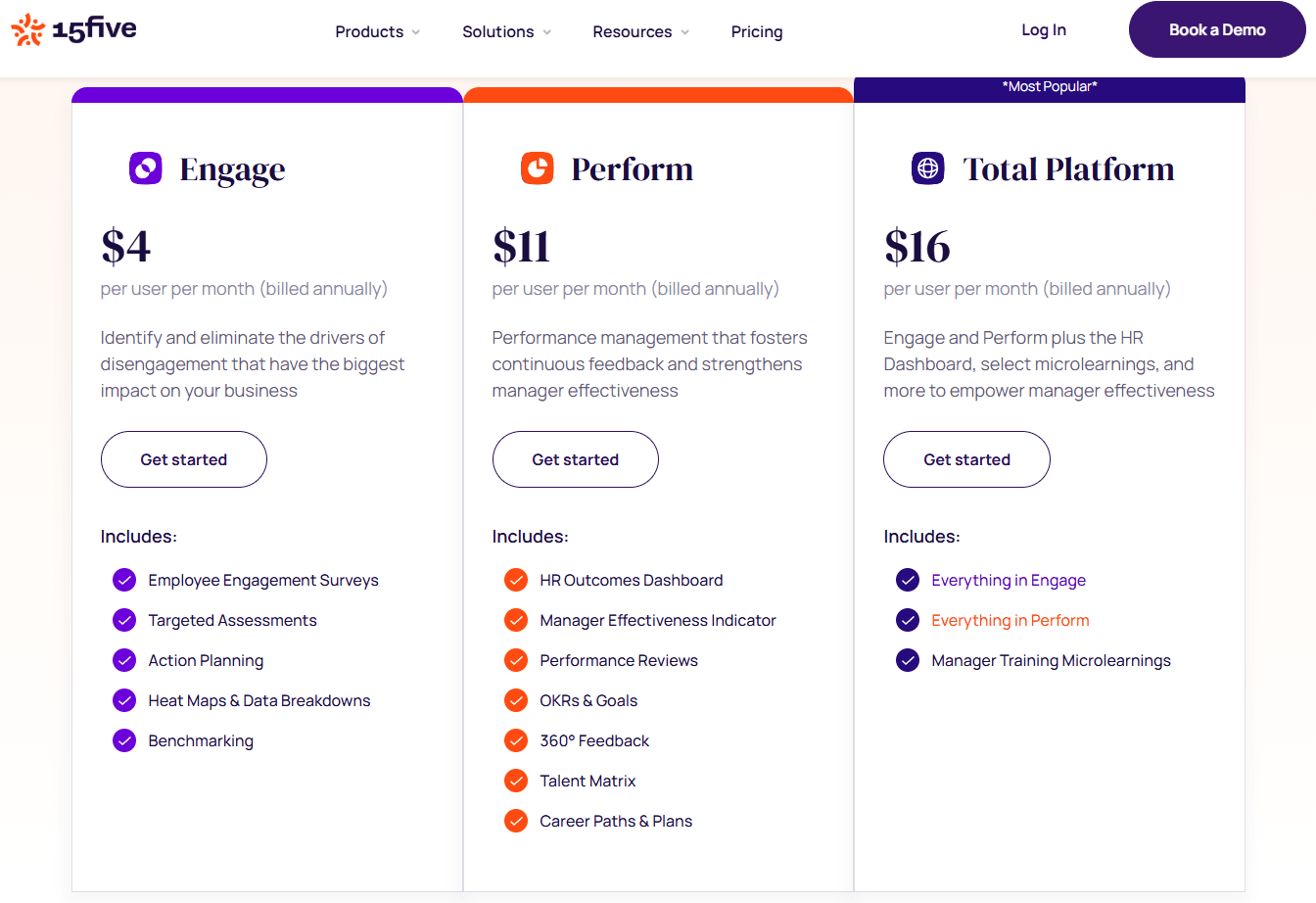
- Free plan: None.
- Engage: $4/user/month, covering engagement surveys, recognition, action planning, heat maps, and benchmarking
- Perform: $11/user/month, adding performance reviews, OKRs, 360° feedback, check-ins, talent matrix, and career paths
- Total Platform: $16/user/month, adding the HR outcomes dashboard and manager training microlearnings
Engagesoft
Engagesoft is an AI-powered employee satisfaction and engagement platform built on organizational psychology frameworks. It's designed for HR teams that need more than survey data: they need a clear path from feedback all the way to action.
Best for
Data-driven HR teams at larger organizations who need comprehensive, research-backed surveys that go beyond satisfaction scores into broader topics like overall employee wellbeing, organizational culture, and exit insights from former employees.
Key features
- Science-backed diagnostic surveys
- AI-driven diagnostics and sentiment analysis on open-ended responses
- Heatmaps and color-coded org chart visibility for complex data across large organizations
- Employee lifecycle tracking covering onboarding, performance reviews, exits, and more
- Tailored action plans based on survey results
- Industry and regional benchmarking
- Anonymous feedback collection
- Integrations with HR, IT, and operations tools
- Online academy, knowledge base, and insights library
Pricing
- Free plan: None.
- Paid plans: Custom pricing. Contact Engagesoft directly for a quote.
Why Porsline Is The Best Employee Satisfaction Measurement Tool
Porsline stands out because it helps HR teams move from idea to live survey faster without giving up control. You can create a first draft with AI, import an existing Word or Excel question bank, customize the structure with logic and scoring, then analyze responses in real time.
That matters in HR because most teams are not starting from zero. They often already have performance review forms, competency models, onboarding checklists, exit interview questions, or engagement survey drafts. Porsline helps turn those assets into structured online surveys instead of rebuilding everything manually.
Most satisfaction tools either limit how much data you can collect or charge you more as your team grows. Porsline removes that constraint entirely. Paid plans include unlimited responses at a flat rate, so your costs stay predictable no matter how many surveys you run or how many employees take part.
All responses appear in real time and export as a single Excel file, which makes sharing results with leadership straightforward rather than a formatting exercise.
The platform also gives you a level of data control that most tools don't offer.
You can customize response formats using regex patterns, restrict file uploads to specific file types, and use encrypted URL parameters to protect sensitive data passed through survey links. The customizable slug feature keeps your survey URLs clean and on-brand rather than a string of random characters.
A few things that genuinely set Porsline apart from other tools in this category:
- Advanced calculations for complex scoring and personality assessments
- Respondent authentication via SMS codes or email verification
- Built-in scoring and computational variables to calculate engagement indexes directly within surveys
- Advanced score filtering to identify and follow up with employees or teams showing lower engagement
- WhatsApp integration for live chat with employees during surveys
- Instant notifications via SMS or Telegram when a survey is completed
- Two display modes: a conversational format for higher engagement or a classic single-page layout
- Question timers, full respondent anonymity controls, and advanced filters to analyze specific data segments
Whether you're running a quick pulse check or a full employee satisfaction program across multiple departments, Porsline gives you the tools to do it properly from day one.
Start a free trial to see how it works.
How to Design an Employee Satisfaction Survey That Gets Honest Answers
The tool matters, but so does the survey itself. Here's what actually makes the difference in response quality.
- Keep surveys short and focused. Survey fatigue happens quickly, so try to stick to 8 to 15 questions. Use quick pulse surveys for regular check-ins, and save longer surveys for quarterly or yearly reviews.
- Use both standard metrics and open-ended questions. Scores like ESI and eNPS show where you stand, but open-ended feedback explains why. Even a single question like "What's one thing we could do to improve your experience here?" can give you more useful insights than a rating scale.
- Make sure employees know their responses are anonymous. People are only honest if they trust their identity is safe. Explain this clearly at the start of the survey, and remind managers they won’t see individual answers.
- Personalize surveys with role-based logic. For example, questions about remote work don’t apply to warehouse teams. Use branching logic so employees only see questions relevant to them. This respects their time and gives you better data.
- Take action on survey results and follow up with your team. If you ignore feedback, people are less likely to participate next time. Share what you learned, explain what you’ll do about it, and check in again later. When employees see their feedback leads to real changes, they’re more likely to keep participating.
It takes some trial and error to get this right, but better survey responses and higher morale make it worth the effort.
Common Mistakes When Measuring Employee Satisfaction
Even well-intentioned programs make avoidable mistakes. These are the ones that tend to come up most often.
- Surveying once a year and calling it done. Traditional annual surveys give you one snapshot in time. A lot happens between cycles: team changes, leadership shifts, policy updates, and none of it gets measured. Combine annual benchmarking with regular pulse surveys to support employee retention and maintain a continuous read on workplace culture.
- Ignoring segmentation. An overall satisfaction score of 7.2 looks fine until you break it down by department and find one team sitting at 4.1 while another is at 9.0. Without segmentation, problems hide comfortably in the averages.
- Asking leading or double-barreled questions. "Do you think management communicates effectively and handles conflicts well?" is actually two questions rolled into one. Keep questions neutral, specific, and focused on a single topic.
- Using tools without automatic scoring. If you're calculating ESI or eNPS by hand after every survey cycle, you're spending time on something any decent platform should handle for you.
- Not protecting anonymity properly. A small team of three people submitting "anonymous" responses isn't really anonymous. Anyone can guess. Set minimum response thresholds before results are shown, and be upfront about how this works.
- Treating satisfaction and engagement as the same thing. A satisfied employee is comfortable and content. An engaged employee is motivated, committed, and going beyond what's required. Measure employee engagement metrics alongside satisfaction scores. Engaged employees tend to drive overall organizational success in ways that satisfied-but-disengaged ones simply don't.
Avoiding these mistakes doesn't take a complicated setup. It mostly takes thinking them through before you launch.
Conclusion About Employee Satisfaction Measurement Tools
Poor employee satisfaction rarely announces itself clearly. It shows up in rising absenteeism, flat productivity metrics, and the quiet exit of people who were worth keeping. By the time most organizations recognize the pattern, the cost of employee turnover has already added up significantly.
The tools in this guide give HR teams and business leaders a way to spot those signals early and take action that genuinely improves the employee experience, from employee happiness and workplace morale to team satisfaction and overall employee wellbeing.
Whether you need simple pulse check-ins or a fully customized ESI program with automatic scoring and multilingual support, the right platform turns feedback into something you can actually use.
Porsline is the strongest all-round choice: flexible enough for any organization size, deep enough to measure satisfaction properly, and affordable enough to get started today.
Start a free trial with Porsline and build your employee satisfaction program the right way.