


Companies that want to improve the customer experience use customer feedback to guide decisions about product development, service delivery and support. Customers can now compare alternatives and assess the quality of an experience more easily, so completing a purchase or not submitting a complaint does not necessarily mean that they are satisfied.
Well-written customer survey questions help reveal the gap between what customers expect and what they actually experience. By reviewing the answers, customer experience, marketing and customer-service teams can identify recurring problems, understand the reasons behind customer ratings and prioritise improvements using real data rather than assumptions.
A successful survey does not depend on asking as many questions as possible. It depends on choosing the right question for the objective, timing and customer touchpoint. You can begin with our comprehensive guide to measuring and improving customer satisfaction to understand the main customer satisfaction metrics, then use this article to select suitable questions about your product, service, support or user experience.
You will also find explanations of CSAT, NPS and CES questions, examples of open-ended and rating-scale questions, and a practical way to use the Customer Expectations Pyramid to build a survey that turns customer feedback into actionable decisions.
Customer Survey Question Examples
Creating a customer satisfaction survey begins with deciding what you want to learn from the responses. You may need to measure satisfaction with a specific interaction, understand how easy it was to access a service, assess the likelihood of a customer recommending your brand, or collect detailed feedback to guide product improvements.
You do not need to include all the questions below in a single survey. Choose questions that match your objective and the customer’s journey stage, then adapt the wording to the product, service or touchpoint you want to evaluate. You can also begin with the Customer Satisfaction Survey Template and customise its questions and response options to suit your needs.
CSAT Questions for Measuring Customer Satisfaction
Customer Satisfaction Score, or CSAT, measures how satisfied a customer is with a specific experience, such as making a purchase, contacting support or using a service.
You can phrase the question as follows:
How satisfied are you with the product or service you received?
Suggested response options:
Very dissatisfied — Dissatisfied — Neither satisfied nor dissatisfied — Satisfied — Very satisfied
You can also tailor the question to the touchpoint:
- How satisfied are you with the purchasing process?
- How satisfied are you with the speed of service delivery?
- How satisfied are you with the support you received?
- How satisfied are you with your most recent experience with us?
NPS Questions for Measuring Loyalty and Recommendation Likelihood
Net Promoter Score, or NPS, measures a customer’s willingness to recommend a company or product. It typically uses a scale from 0 to 10.
The main question is:
How likely are you to recommend our products or services to a friend or colleague?
You can follow it with an open-ended question to understand the reason for the rating:
What is the main reason for the score you selected?
The follow-up question helps you understand the factors influencing customer satisfaction or hesitation rather than relying on the numerical score alone. You can use the NPS Survey Template as a starting point.
CES Questions for Measuring Customer Effort
Customer Effort Score, or CES, measures how easy or difficult it was for a customer to complete a specific task, such as using a feature, completing a purchase or resolving a problem with the support team.
You can phrase the question as follows:
How easy was it to complete your task or obtain the solution you needed?
Suggested response options:
Very difficult — Difficult — Neither difficult nor easy — Easy — Very easy
Alternative versions include:
- How easy was it to use the product to complete your task?
- How easy was it to get help from the support team?
- How easy was it to complete the purchasing process?
- How much effort did you need to make to resolve your problem?
The question “Did our product or service solve your problem?” measures whether the solution worked and whether the customer achieved the intended outcome. It does not measure the effort required from the customer.
A Quick Comparison of CSAT, NPS and CES
| Metric | What does it measure? | Sample question |
|---|---|---|
| CSAT | Customer satisfaction with a specific experience or interaction | How satisfied are you with your most recent experience? |
| NPS | The likelihood that a customer will recommend the brand and their overall level of loyalty | How likely are you to recommend us to a friend or colleague? |
| CES | How easy it was to complete a task or obtain a solution | How easy was it to complete your task or get the solution you needed? |
CSAT, NPS and CES should not be treated as interchangeable metrics. Each answers a different question about the customer journey.
For example, a customer may be satisfied with the outcome of a support interaction, but reaching the solution may have required too many steps or taken too long. In this case, the CSAT score could be high while CES reveals friction that still needs to be addressed.
Product Usage Questions
These questions help you understand how customers use the product and the value they receive from it:
- How often do you use this product or service?
- Has the product helped you achieve the goal for which you started using it?
- Which part of the product is most useful to you?
- Which feature do you use most often?
- Have you experienced any difficulty while using the product?
- If you could improve one aspect of the product, what would you change?
- How would you rate your overall experience with the product?
You can use a balanced response scale for the final question:
Very poor — Poor — Acceptable — Good — Excellent
You can also retain the question “Did our product or service solve your problem?” in this section. It measures whether the product delivered the intended outcome, rather than the level of effort required from the customer, which is measured by CES.
Customer Satisfaction Questions About Services
These questions help service-based organisations assess the quality of service delivery and how closely the customer’s experience matched their expectations:
- To what extent did the service meet your expectations?
- How would you rate the quality of the service you received?
- Was the service delivered at the agreed time?
- Were the steps required to access the service clear?
- Which aspect of the service needs the most improvement?
- Would you use this service again?
Customer Service and Support Evaluation Questions
You can send these questions after a support conversation has ended or a customer request has been resolved.
Questions should refer to a specific, recent interaction whenever possible. This makes it easier for the customer to remember the details of the experience and provide a more accurate response.
- How satisfied are you with the support you received?
- Did the support representative understand your problem clearly?
- Did you receive an appropriate solution to your enquiry?
- How would you rate the response time?
- How easy was it to contact the support team?
- What could we have done to improve your experience?
Website User Experience Survey Questions
You can use these questions to evaluate the customer’s experience with a website or application without limiting the survey to one technical feature:
- How easy was it to find the information you were looking for?
- Were you able to complete the task that brought you to the website?
- How would you rate the ease of navigating between pages?
- Were the instructions and steps clear?
- Did you encounter a technical problem or anything that was unclear?
- Which part of the website or application was most useful?
- What improvement would make your experience easier?
Rating-Scale Questions for Measuring Satisfaction
Customer satisfaction can be measured using several types of response scale. The appropriate format depends on the nature of the question and how you intend to analyse the results.
Numerical rating scale
How satisfied are you with our services on a scale from 1 to 10?
Here, 1 means not at all satisfied, while 10 means completely satisfied.
Likert scale
To what extent do you agree with the following statement?
“The product was easy and clear to use.”
Strongly disagree — Disagree — Neither agree nor disagree — Agree — Strongly agree
Visual scale
Choose the symbol that best represents your experience:
Satisfied — Neutral — Dissatisfied
Keep the direction of the scale and the meaning of each score consistent throughout the survey. This makes responses easier to compare and analyse. You can also consult our guide to Likert scales when choosing the number of points and suitable response labels.
Open-Ended Questions for Detailed Customer Feedback
Open-ended questions allow customers to describe their experience in their own words. They help you understand the reasons behind numerical ratings and uncover problems or suggestions that may not appear in predefined response options.
You can use the following questions:
- In your own words, tell us about your experience with our brand.
- How could we improve your experience with us?
- Which aspect of the product or service did you like most?
- What could our employees do to improve the service?
- What was the main problem you encountered?
- Do you have any other comments or suggestions you would like to share?
It is usually best to include one or two open-ended questions after the main rating questions. This gives you context for the customer’s score without making the survey unnecessarily long or demanding.
Customer Survey Questions for WhatsApp
When sharing a survey link through WhatsApp, it is best to keep the survey brief and connect it to a recent customer experience. It may include the following questions:
- How satisfied are you with your most recent experience with us?
- Did you receive the product or service you expected?
- How easy was it to complete your request?
- What is the one thing we could improve?
Send a short message explaining why you are conducting the survey and how long it is likely to take, followed by the survey link. This helps customers understand what is being asked before they open the form and reduces uncertainty about the next step.
The goal is not to collect as many questions as possible. Choose questions that support a clear decision. When you do not know how the answer to a particular question will be used to improve the product, service or support experience, the question may not need to be included.
What Is the Customer Expectations Pyramid?
The Customer Expectations Pyramid is a practical framework that helps companies understand what customers expect from an experience—from receiving the promised product or service to developing a relationship that provides value beyond the purchase itself.
The pyramid should not be used as a standalone customer satisfaction metric. Instead, it can help you organise the themes of your survey and identify the areas that require evaluation.
Rather than asking only a broad question such as “Are you satisfied?”, you can distribute questions across several levels covering delivery quality, access to service, understanding the customer’s needs and the additional value they receive.
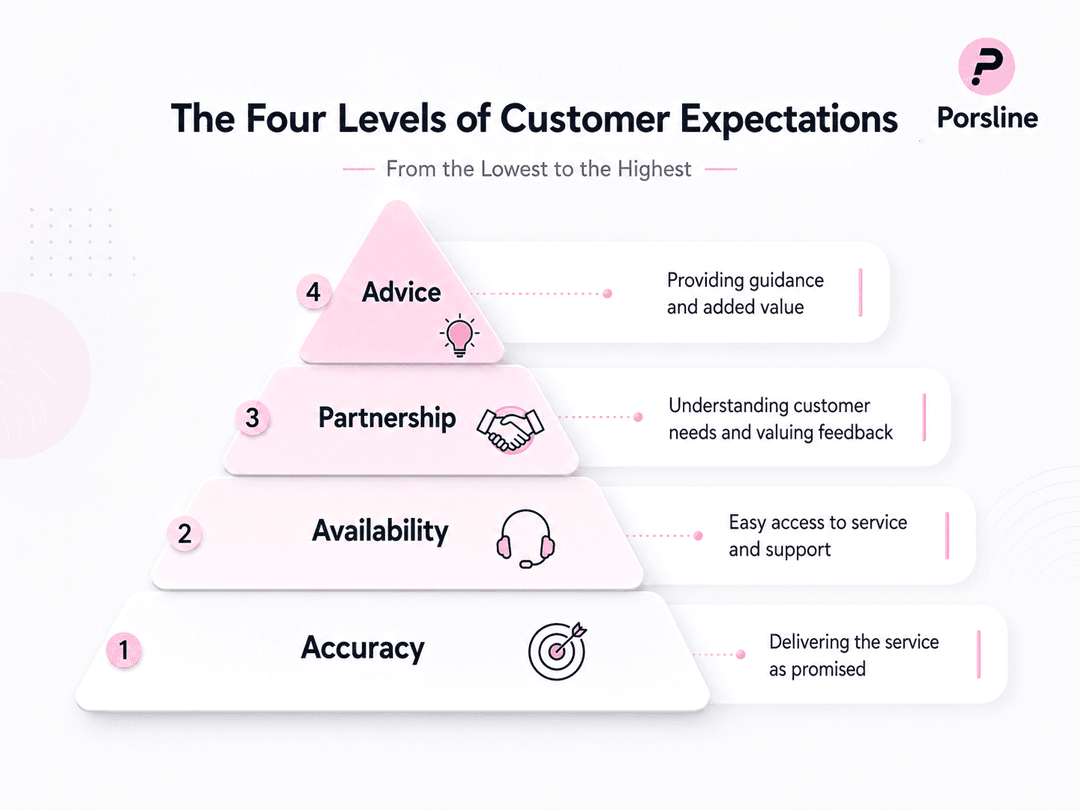
The Four Levels of the Customer Expectations Pyramid
The four levels move from the most basic expectation to the most advanced.
1. Accuracy
Accuracy represents the customer’s fundamental expectation: receiving the product or service that was promised, with the agreed specifications, timing and method of delivery.
For example, a hotel guest expects to receive the type of room they booked. An online shopper expects the correct product to arrive, while a user of a digital platform expects its core service to work as described.
When these basic expectations are not met, additional features or good communication are unlikely to compensate for the failure.
Questions that can measure this level include:
- Did you receive the product or service as you expected?
- Was your request fulfilled correctly?
- Was the service delivered at the agreed time?
2. Availability
Availability refers to the customer’s ability to access the product, service, information or support when needed.
This level is not limited to having a branch or employee available. It also includes clear communication channels, ease of access to assistance and the availability of the information customers need before and after a purchase.
Suitable questions include:
- How easy was it to access the service you needed?
- Were you able to contact us through a channel that suited you?
- How easy was it to get help after your purchase?
3. Partnership
Partnership begins when customers feel that the company is not treating them as a transaction alone, but is listening to their needs and trying to understand the context in which they use the product or service.
This level is reflected in attention to feedback, personalised communication, problem follow-up and the use of customer feedback to improve the experience.
Questions that measure this level include:
- To what extent do you feel that we understand your needs?
- Do you feel that your feedback is taken seriously?
- How well did the proposed solution match your needs?
4. Advice
At this level, customers expect guidance or knowledge that helps them get more value from the product or service, rather than simply receiving what they purchased.
This value may take the form of a relevant recommendation, clearer instructions, help avoiding a problem or guidance towards the option that best suits the customer’s needs.
Suitable questions include:
- How useful were the recommendations you received?
- Did our guidance help you use the product more effectively?
- What type of advice or information would you like to receive in the future?
Using these levels when preparing a customer satisfaction survey helps you move from measuring a general impression to diagnosing the experience more accurately.
A customer may be satisfied with the quality of the product but find it difficult to access support. They may also feel that the company does not understand their needs or does not provide enough guidance to help them benefit fully from the service.
For this reason, choose one or more questions from each relevant level according to the customer journey, then analyse the results to identify the source of the gap and prioritise improvements.
How to Measure and Meet Customer Expectations with Survey Questions
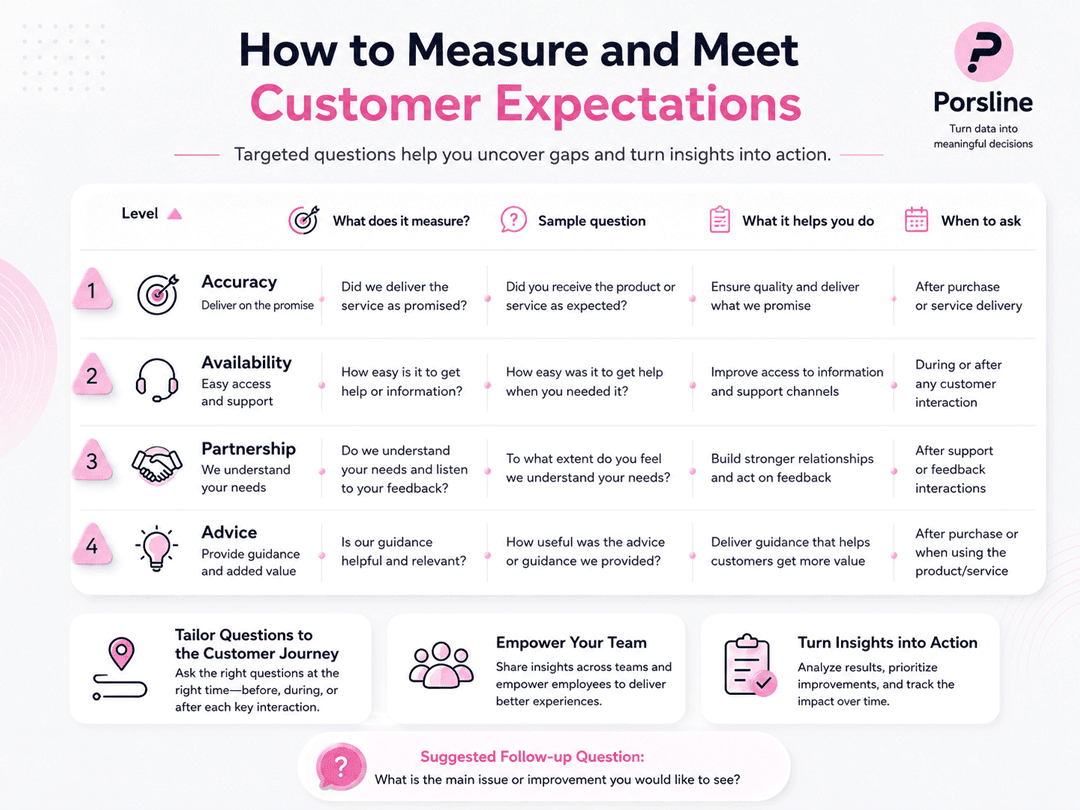
Once you have identified the different levels of customer expectations, the next step is to turn each level into clear questions that reveal whether the actual experience matches what the customer expected.
A general question about satisfaction is not always enough. A customer may be satisfied with the quality of the product but find it difficult to access support or feel that the company does not understand their needs. Distributing questions across Accuracy, Availability, Partnership and Advice helps you identify the source of the gap rather than relying on a single satisfaction score.
| Customer expectation level | What should you measure? | Suggested question |
|---|---|---|
| Accuracy | Whether the core promise was fulfilled and the service was delivered correctly | To what extent did you receive the product or service you expected? |
| Availability | Ease of access to the service, information or support | How easy was it to get help when you needed it? |
| Partnership | How well the company understands the customer’s needs and responds to their feedback | To what extent do you feel that our team understands your needs? |
| Advice | The value of the guidance or knowledge provided to the customer | How useful was the advice or guidance we provided? |
You can add an open-ended question after each theme when you need to understand the reason behind a rating. For example, when a customer gives a low score for access to support, you could ask:
What was the main difficulty you encountered when trying to get help?
This follow-up moves the analysis from identifying that a problem exists to understanding its cause. However, understanding the cause does not create improvement by itself. The next step is to convert what the responses reveal into specific decisions, assign responsibility for implementing them and monitor their effect on the customer experience.
Link Survey Results to Clear Actions
The value of a survey does not come from collecting responses alone. The team must know how each result will be used to improve the experience.
When responses indicate a problem with Accuracy, you may need to review order fulfilment procedures, service execution or the clarity of the promises made to customers. When the problem relates to Availability, the priority may be to improve support channels or make information easier to access.
At the Partnership level, the results may show that customers do not feel their feedback is taken seriously. This may require better follow-up and communication. A weak result at the Advice level may indicate that customers need user guides, recommendations or educational content that helps them get more value from the product.
Prepare Employees to Manage Customer Expectations
Survey findings should not remain within the customer experience team. Share them with the teams that directly influence the experience, including marketing, sales, support and operations, and identify the areas each team can improve.
Training employees to listen to customers, explain processes clearly and manage expectations realistically also helps reduce the gap between what was promised and what the customer actually experienced.
Tailor Questions to the Customer Journey Stage
The most appropriate questions depend on where the customer is in their journey.
Before a purchase, you can measure the clarity of the information provided and how easy it was to find answers. After a purchase, you can assess delivery quality and ease of use. Following a support interaction, it may be more appropriate to measure response speed and how easy it was to resolve the problem.
Do not use the same survey in exactly the same way at every stage. Select a limited number of questions related to the interaction the customer has just experienced, then compare the results over time to identify which improvements deserve priority.
The purpose of measuring customer expectations is not to fulfil every individual request separately. It is to identify recurring patterns and turn them into realistic improvements across the product, service and customer communication.
How to Choose and Write Customer Satisfaction Survey Questions
The quality of a customer satisfaction survey does not depend on the number of questions it contains, but on how closely each question supports a clear objective. A well-designed question can help you identify a problem, compare results or decide what action to take. A vague or biased question, by contrast, produces answers that are difficult to interpret and use.
Define the Purpose of Every Question
Begin by identifying the decision you want the answers to support. Do you want to measure satisfaction with the purchasing process, evaluate how easy the product is to use or understand why some customers are dissatisfied?
Instead of asking a broad question such as:
What do you think of our company?
Use a more specific question:
How satisfied are you with the speed at which your most recent order was fulfilled?
The clearer the objective, the easier it becomes to choose the right question, select an appropriate response format and analyse the results.
Choose the Right Question Type and Response Scale
Use closed-ended questions when you need to compare responses or calculate a metric. Use open-ended questions when you want to understand the reasons behind a rating or uncover problems you did not anticipate.
For example:
- Use a five-point scale to measure satisfaction.
- Use a scale from 0 to 10 for an NPS question.
- Use an open-ended question to understand the reason behind a score.
- Use a yes-or-no question to confirm whether a specific event occurred, rather than to measure the degree of satisfaction.
Keep the direction of your scales and the meaning of each score consistent throughout the survey so customers do not have to reinterpret the response options for every question.
Make Every Question Clear and Focused on One Idea
Avoid combining several subjects in the same question. The following question is difficult to answer accurately:
How satisfied are you with the product quality, delivery speed and customer service?
A customer may be satisfied with the product but dissatisfied with the delivery. It is therefore better to divide this into three separate questions.
Use familiar language and specify the experience or period you are asking about, such as “your most recent order” or “your most recent conversation with the support team”, rather than leaving the question open to different interpretations.
Avoid Leading Questions and Unbalanced Response Options
Do not use wording that encourages the customer to give a positive response, such as:
How much did you like our exceptional service?
A more neutral version is:
How would you rate your experience with the service?
Response options should also be balanced. If a scale begins with “Very poor”, it should end with “Excellent”, with clearly graduated options between the two ends.
Keep the Survey Only as Long as Its Purpose Requires
Do not add a question simply because it appears important. Before approving any question, ask:
- What will I do with this answer?
- Has the same question already been asked in another form?
- Can the customer answer it based on an experience they can remember?
- Does the question need predefined response options or an open-ended comment?
Arrange the questions from the simplest to the most detailed, and place open-ended or sensitive questions later in the survey. Test the survey with a small number of people before publishing it to make sure that the questions, response options and sequence are clear.
How to Create a Customer Survey in Porsline
Once you have chosen the most relevant customer survey questions, you can turn them into an online survey in Porsline, share it with customers, review the responses and analyse the results in one place.
The following video explains how to create an online survey in Porsline, add and customise questions, and prepare it before sharing it with customers.
1. Choose How to Create the Survey
Begin by logging in to your Porsline account, then select Create new survey. You can choose the method that best fits your needs:
- Use the ready-made Customer Satisfaction Survey Template and customise its questions.
- Select Start from scratch to build a new survey.
- Select Create new survey with AI to generate an initial draft, then review and revise the questions.
A ready-made template is useful when you want to begin quickly with a pre-built structure. Starting from scratch gives you greater control over the question types and their order.
2. Tailor the Questions to the Customer Experience
Do not copy every question from this article into a single survey. Select the questions that correspond to the touchpoint you want to measure, such as:
- The purchasing experience.
- Product usage.
- Service quality.
- An interaction with the support team.
- The website or application experience.
- The likelihood of recommending the brand.
You can combine a closed-ended rating question with a short open-ended question to understand the reason behind the score.
You can also use Logic to display different follow-up questions according to the customer’s answer. This ensures that each respondent sees only the questions relevant to their experience.
3. Review the Question Order and Response Experience
Begin with simple, direct questions before moving to detailed or open-ended questions.
Review the response options to make sure that they are clear and balanced. Before publishing, test the survey to confirm that it displays and works as intended on mobile devices and computers.
4. Share the Survey with Customers
After completing the survey, go to Share to obtain its link.
You can send the link through email or WhatsApp, post it on social media, share it as a QR Code or embed the survey on your website.
Choose the distribution channel and timing according to the customer journey stage you want to measure. For example, you could send a short survey:
- After an order has been completed.
- After a support conversation has ended.
- After the customer has used the product long enough to assess the experience.
5. Review Responses and Analyse the Results
You can monitor responses in the Results phase. Open the Results Table to review the collected answers, then use Charts to examine response distributions and compare satisfaction indicators.
Do not rely only on the overall average. Review open-ended comments, questions that received low ratings and differences between customer journey stages.
You can also export the results to Excel or CSV when you need to share the data or conduct additional analysis.
Following these steps helps you move from a general list of questions to a focused survey with a clear objective—one that organises customer feedback and identifies the aspects of the experience that require improvement.
Conclusion
Collecting customer feedback is not enough on its own. The real value begins when you choose questions that support a clear objective and use the responses to identify what needs to improve across the product, service or support experience.
Begin with a question that measures satisfaction, effort or recommendation likelihood, then add an open-ended follow-up to understand the reason behind the rating. Keep every question clear and neutral, focus it on one idea and use balanced response options that are easy to analyse and compare.
After collecting responses, look for recurring patterns rather than treating every answer in isolation. The results may reveal a problem with delivery quality, difficulty accessing support or a gap between what customers expected and what they actually experienced. These findings can then be converted into clear priorities that relevant teams can act on.
Start with the ready-made Customer Satisfaction Survey Template, then customise the questions to match your customer journey and the aspect of the experience you want to measure.
FAQs About Customer Survey Questions
What Are the Most Important Questions to Include in a Customer Satisfaction Survey?
The right questions depend on the survey’s objective. A useful survey should normally include a question that measures satisfaction with the experience, a follow-up question that explains the rating and a question related to the specific area you want to improve, such as product quality, service speed or support.
You can begin with questions such as:
- How satisfied are you with your experience with us?
- What is the main reason for your rating?
- Which aspect needs the most improvement?
- How likely are you to recommend us to a friend or colleague?
What Is the Difference Between CSAT, NPS and CES?
CSAT measures customer satisfaction with a specific experience or interaction, such as a purchase or support conversation.
NPS measures how likely a customer is to recommend the company, brand or product.
CES measures how easy it was for the customer to complete a task or obtain a solution.
Choose the metric according to what you want to understand: satisfaction with a particular interaction, overall loyalty or the level of effort required from the customer.
How Many Customer Survey Questions Should You Ask?
There is no fixed number that suits every survey. Include enough questions to support a clear objective, but avoid questions whose answers will not be used to make a decision.
For a survey linked to a specific interaction, one main rating question and one open-ended follow-up may be sufficient.
A broader survey can be divided into themes such as the product, service and support, with a limited number of questions under each theme.
What Is the Difference Between Open-Ended and Closed-Ended Questions?
A closed-ended question provides predefined response options, such as a satisfaction scale or a yes-or-no choice. This makes responses easier to compare and analyse.
An open-ended question allows customers to answer in their own words. It is useful for understanding the reasons behind a rating or discovering problems and suggestions that were not included in the response options.
Combining the two is often the most effective approach: use a closed-ended question for measurement, followed by an open-ended question to understand the reason behind the response.
When Should You Send a Customer Satisfaction Survey?
Send the survey close to the experience you want to evaluate so that the customer can still remember its details.
You may send it after:
- A purchase has been completed.
- A product has been delivered or a service provided.
- A support conversation has ended.
- The customer has used a new feature.
- An event or training programme has finished.
- The customer has used the product long enough to evaluate it.
The timing should match the survey’s objective. Do not request an evaluation before the customer has had enough opportunity to experience what you want them to assess.
Can You Send a Customer Survey via WhatsApp?
Yes. You can share the survey link through WhatsApp, as well as by email, social media and other distribution channels.
When using WhatsApp, keep the message brief, explain why you are requesting feedback and include only a limited number of questions related to a recent experience. This helps the customer understand the request before opening the link and makes the survey easier to complete.
How Can You Avoid Bias in Customer Satisfaction Questions?
Use neutral language that does not encourage a positive or negative answer. Avoid describing the product or service with words such as “exceptional” or “excellent” inside the question.
Ask about one idea at a time and provide balanced response options.
Instead of asking:
How much did you like our exceptional service?
Ask:
How would you rate your experience with the service?