



The best market research survey tools let you collect feedback straight from your audience. They make survey creation easy, target the right people, and break down the data so you get deeper insights you can actually use.
This guide covers what you need to know about market research software. You’ll see different survey types, tips for planning your research, and what features actually matter.
We’ll also compare five top platforms, so by the end, you’ll have a pretty solid idea which one fits your needs and how to start getting real customer insights.
Five Types Of Market Research Surveys

Market research questionnaires help you dig into a specific part of your market. Picking the right type gets you closer to the answers you need.
- Competitor research surveys show you how your brand stacks up against others. You’ll learn what customers think about your competitors’ products, pricing, and service. This kind of survey uncovers market trends and can highlight gaps in the marketplace just waiting for you to fill.
- Consumer behavior surveys track how people interact with products and services. You’ll get a look at purchase behavior, shopping habits, and the journey from first hearing about you to actually buying. This qualitative research helps you see patterns and understand why people make the choices they do. Sometimes, the “why” is more interesting than the “what.”
- Brand awareness surveys measure how well people recognize and remember your brand. You’ll find out what emotions and associations customers link to your business. These surveys often include sentiment analysis to gauge overall brand perceptions and customer feelings.
- Price-testing surveys help you figure out the sweet spot for your pricing. You can use conjoint analysis to see which features matter most and what people are willing to pay for. Getting this right means you don’t price too high or leave money on the table.
- Concept testing surveys let you test new ideas before you launch them. You’ll gather open-ended responses and thoughtful responses about new products, campaigns, or services.
- Retail audit surveys help you understand how your products perform in real retail environments. You can gather feedback on product availability, shelf visibility, pricing accuracy, and competitor presence. It helps you identify distribution issues, improve in-store execution, and optimize retail performance.
Market researchers often pair these with focus groups for even deeper feedback. If you want a head start, check out some handy survey templates.
How To Plan A Market Research Survey
Planning your market research survey right from the start saves you from junk data and wasted effort. A solid plan means you actually get feedback that helps you make data-informed decisions.
Define your research goal
First, write down the specific research question you need answered.
- What decision are you working toward?
- Are you trying to see how customers feel about your brand, or testing out a new product idea?
Your goal needs to be clear enough that someone else could read it and get what you’re after. Vague goals lead to vague online surveys, and that’s just not helpful.
Identify your target audience and sampling method
Decide who needs to answer your survey for the results to be useful. Your audience should match the decision you’re making.
Do you need a cross-section of all your customers, or just a specific group?
Think about how many survey responses you need to feel confident in your findings. There’s no magic number, but more isn’t always better if they’re not the right people.
Choose the right survey tool and survey type
Pick a survey platform that fits your research needs and your budget. Look for features such as skip logic and attention checks to weed out poor-quality responses.
Some people want simple design tools, while others need advanced targeting options. The right tool makes survey creation less of a chore and boosts your research quality.
Write unbiased questions and structure the survey flow
Keep your questions neutral. Don’t nudge people toward one answer. Avoid loaded language or anything that might sway their thinking.
Structure your survey so it flows from broad to specific topics. Use skip logic to make sure people only see questions that matter to them.
Launch, monitor response quality, and optimize mid-flight
Before blasting your survey to everyone, test it with a small group. Make sure the questions make sense and your logic works.
Watch for red flags in responses, like people speeding through or picking the same answer over and over. It happens more often than you’d think.
Analyze results and turn insights into action steps
Look through your customer data for patterns or surprises. Compare different groups to see if there are any meaningful differences.
Use what you find to create specific action steps.
The best analysis tools connect your survey results right back to the decision you set out to make.
Key Features Of The Best Market Research Survey Tools
Good market research survey tools let you gather customer feedback and turn it into something you can actually use. They make it easier to collect, analyze, and act on what your audience tells you.
| Feature | Description |
| Survey logic (skip logic, branching, piping) | Personalizes question flow based on responses |
| Question randomization | Reduces bias by changing question/answer order |
| Templates for market research surveys | Pre-built formats for common research needs |
| Advanced question types | Includes MaxDiff, conjoint, ranking, and NPS |
| Mobile-friendly design | Ensures surveys work smoothly on all devices |
| Custom branding and themes | Matches surveys to your brand identity |
| Multi-language support | Helps you reach global audiences |
| Distribution options | Sends surveys via email, SMS, share links, or panels |
| Audience targeting | Helps you survey the right customer segment |
| Data quality controls | Filters bots and low-effort responses (attention checks, deduplication) |
| Real-time reporting dashboards | Tracks responses and performance as data comes in |
| Cross-tabs and segmentation | Breaks down results by audience groups and attributes |
| Export options | Supports CSV, Excel, SPSS, and API access |
| Integrations | Connects to CRM, BI, and marketing platforms |
| Collaboration tools | Supports team roles, approvals, and shared reports |
| Security and compliance | Protects data with GDPR, SOC 2, and SSO support |
The best platforms balance powerful analysis with a simple interface, making market research accessible for everyone on your team.
Quick Picks For Market Research Survey Tools
Picking the right market research survey software can really change the quality of your insights. Each platform brings something different to the table, so what matters most to you?
Here are our top picks:
- Porsline: A go-to choice for comprehensive survey design, analytics, and customization. It works for businesses of all sizes and lets you create unlimited surveys with unlimited responses. Start a free trial now.
- Qualtrics: Most useful if you need enterprise-grade analytics and advanced data analysis features.
- Typeform: Suitable when you want engaging, conversational surveys that people actually enjoy completing
- SurveyMonkey: Works if you’re looking for pre-built survey templates and easy-to-use tools.
- Pollfish: Suitable for getting quick responses from a large, ready-to-go audience.
Most survey platforms offer free trials, so you can try them out before you commit. Start with the tool that fits your immediate needs, whether that’s quick feedback, actionable insights or in-depth analysis.
At-A-Glance Comparison Of The Best Market Research Survey Tools
The right market research survey tool can totally change the quality of your insights. Each platform brings its own features, pricing, and strengths—some work better for certain projects than others.
The table below breaks down five top tools. You’ll see what each does best, main strengths, whether there’s a free plan, and what paid plans start at.
| Tool | Best for | Key strengths | Free plan | Starting price |
| Porsline | Budget-conscious teams needing multilingual surveys | Multi-language support, easy drag-and-drop builder, automation + formulas | Yes | €23/month (Pro) |
| Qualtrics | Enterprise research with advanced analytics | Real-time dashboards, AI-powered analytics, deep reporting + integrations | No | Custom pricing (quote-based) |
| Typeform | Engaging, conversational surveys | One-question-at-a-time format, high completion rates, strong design + templates | Yes | $39/month (Basic) |
| SurveyMonkey | General market research and quick surveys | AI survey creation, advanced templates, multi-channel sharing + analytics | Yes | €30/user/month (Team Advantage, billed annually) |
| Pollfish | Fast consumer research with targeted audiences | First-party panel access, detailed targeting, AI fraud detection + fast results | No | $0.95 per response (DIY) |
Consider your budget, team size, and what you actually need to research when comparing.
Deep Dive: Market Research Survey Software Compared
Each platform on our list offers something unique, whether you’re working with panels, chasing trends, or reaching people across the globe. Let’s see how the best market research survey tools compare.
Porsline
Porsline is a user-friendly online form builder that lets you create mobile-ready surveys, quizzes, and forms without any technical experience. Using its drag-and-drop editor, you can build and publish a complete survey in just minutes.
You can create multilingual forms that support English, Turkish, Arabic, Spanish, and Russian.
Porsline also connects with n8n, helping teams automate workflows. Built-in formulas and calculations let you score responses or process data instantly as users complete the survey.
Best for
Porsline is ideal for teams that want to run market research in-house without paying for expensive enterprise tools or outsourcing to agencies. It helps businesses collect insights faster, keep control over their data, and lower research costs while still getting reliable results.
Key features
- Create and distribute any type of market research survey quickly to consumers, panels, or interviewers
- Screen respondents using conditional logic to ensure only your target audience participates
- Automatically segment audiences and build personas using response-based labeling and scoring
- Support field research with location capture, audio, image, and video recording
- Use computational variables to calculate metrics like market share or shelf share automatically
- Restrict survey access using OTP, access codes, or panel authentication
- Build branded consumer surveys, VoC forms, and lead generation forms for websites and campaigns
- Access real-time visual reports and export data to Google Sheets, CRM systems, and other tools
Pricing overview
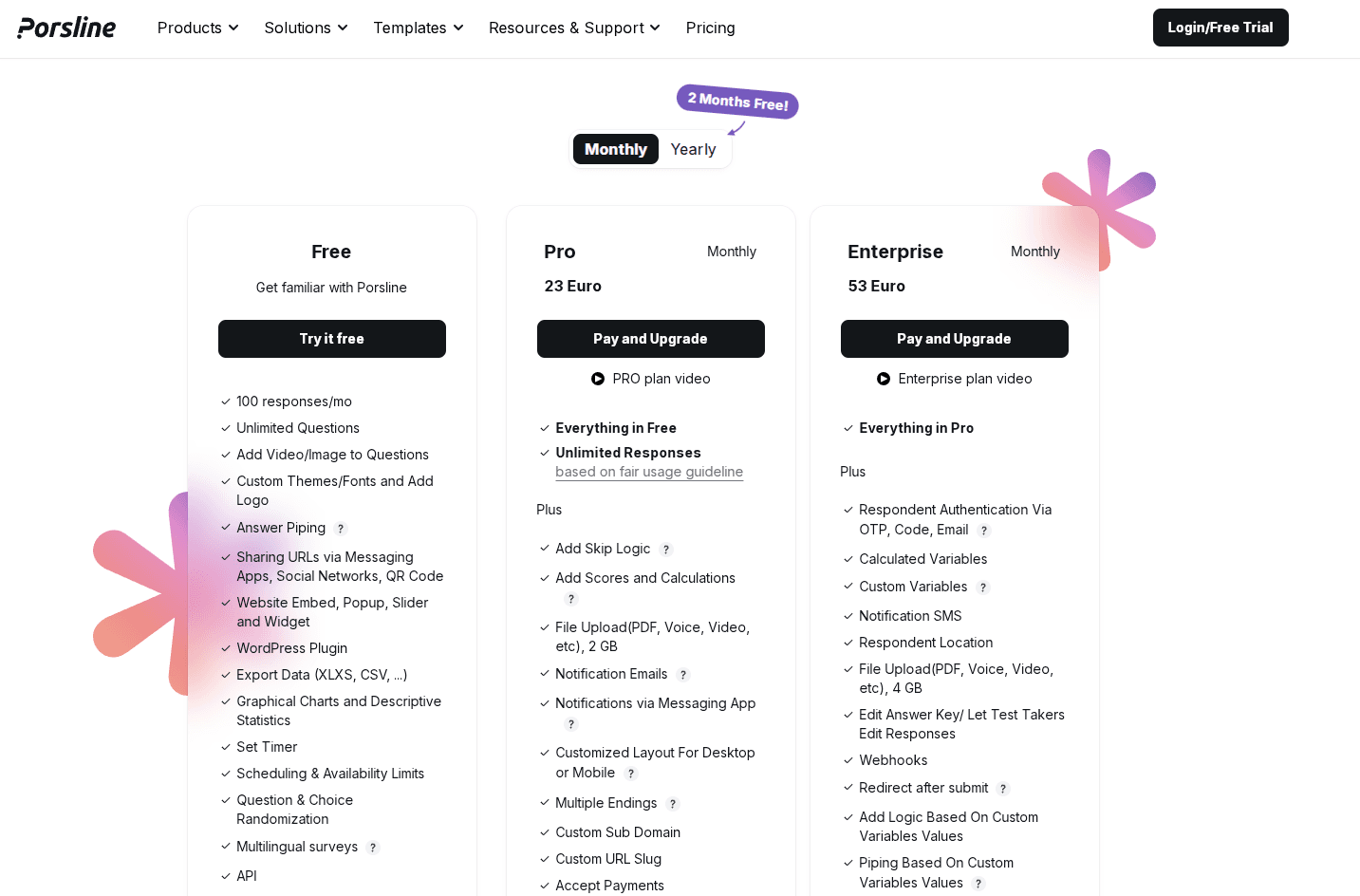
Porsline offers a straightforward pricing structure with an easy upgrade path. The Free plan includes the core survey features, while the Pro plan starts at €23 and unlocks unlimited responses, advanced logic, file uploads, and automated notifications.
For bigger teams, the Enterprise plan adds stronger security and more control, including respondent authentication, webhooks, and SMS alerts.
Qualtrics
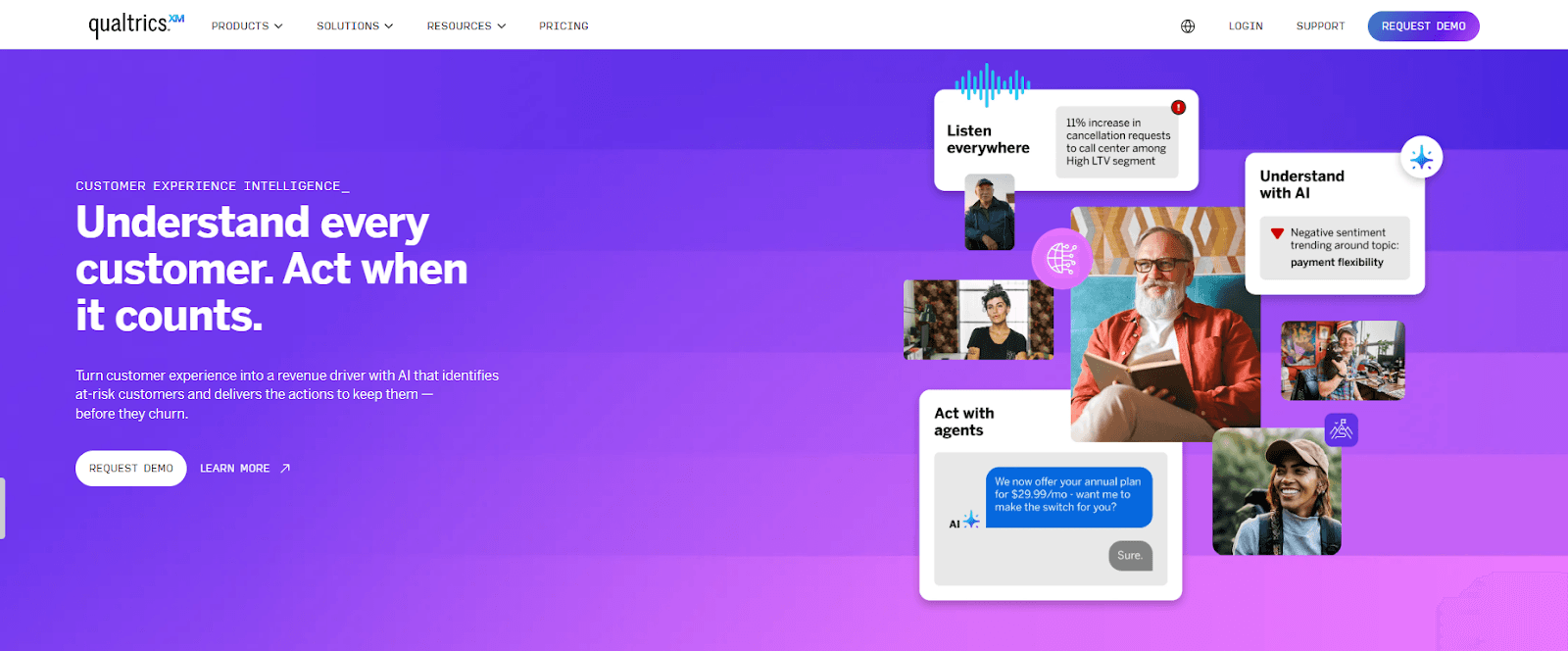
Qualtrics makes it easy to build anything from conversational surveys to advanced market research projects. It’s a strong fit for collecting customer insights, testing new product ideas, and running in-depth research studies.
The platform delivers real-time data and strong reporting, helping teams make faster decisions.
Best for
Qualtrics suits enterprise research teams and organizations that need deeper insights, custom dashboards, and advanced reporting.
Key features
- Drag-and-drop survey builder with tons of customization
- AI-powered analytics (the iQ suite) for large datasets
- Access to global audiences through human and synthetic panels
- Natural language processing for analyzing open-ended responses
- Integration with 125+ data sources, including social media
- Real-time dashboards and automated reporting tools
- Mobile-optimized surveys for every device
- Expert-designed templates to get started quickly
- Smart workflows that flag deeper insights to relevant teams
Pricing overview
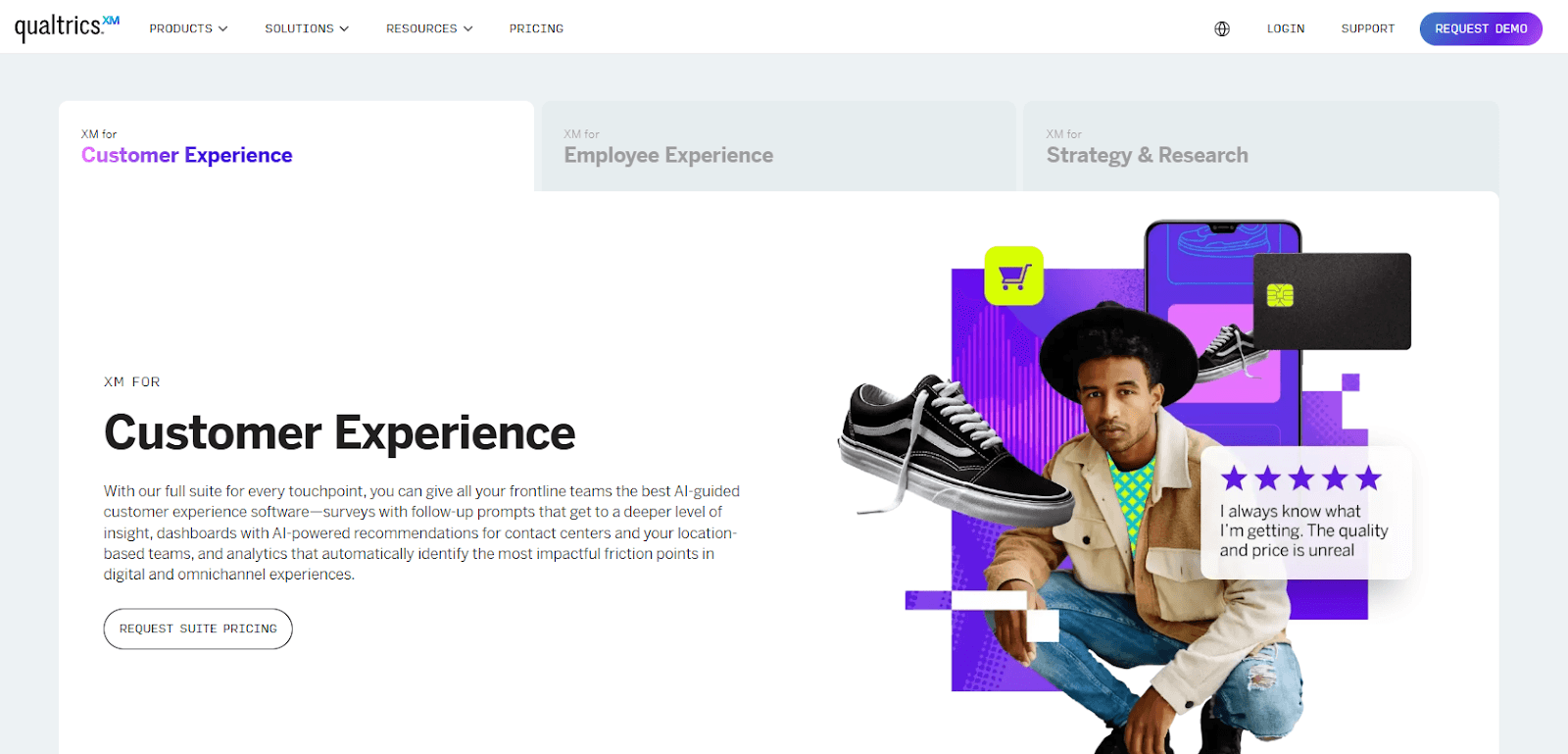
Qualtrics follows a quote-based pricing model, meaning costs depend on factors like your usage needs, the product suite you choose, and how many teams will use the platform.
Rather than offering fixed monthly plans, it organizes pricing around three main solution categories: Customer Experience, Employee Experience, and Strategy & Research.
Since Qualtrics doesn’t publish pricing publicly, you’ll need to request a demo or pricing quote to get an exact cost.
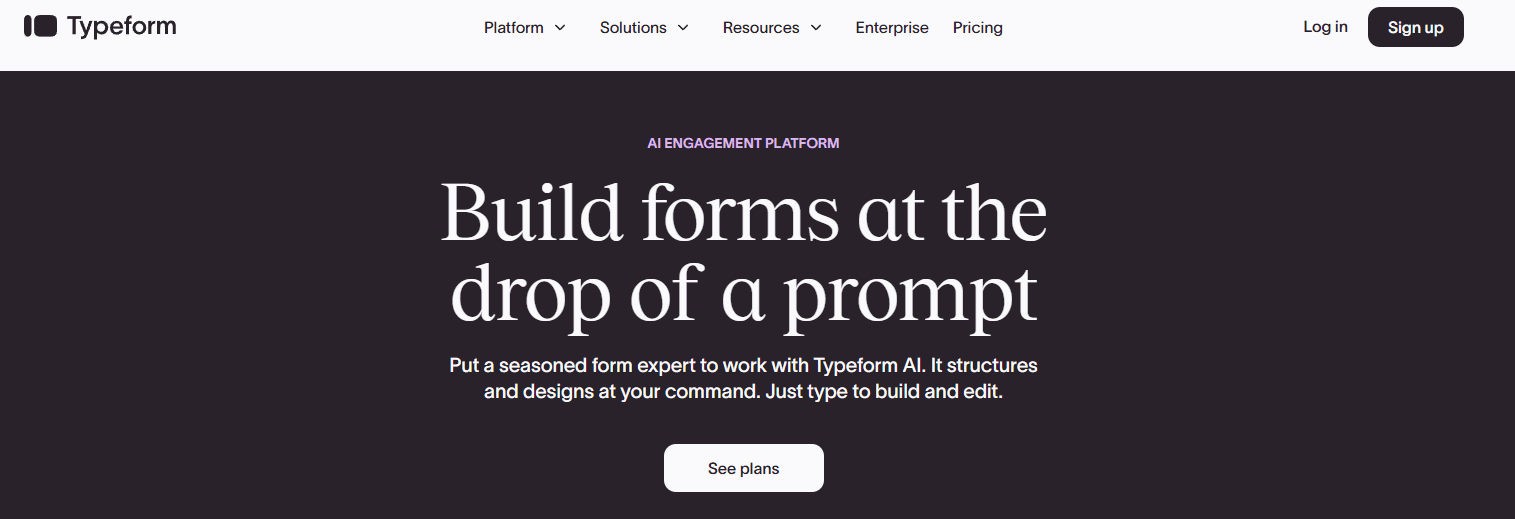
Typeform stands out by making surveys feel like conversations instead of boring forms. Its one-question-at-a-time format keeps people engaged and more likely to finish.
You can build surveys fast and analyze results with AI-powered tools, creating custom surveys that feel friendly and natural. You can customize them for your brand or research needs.
Typeform also helps you reach global audiences with automatic translation.
Best for
Businesses that want higher response rates and more detailed feedback with conversational surveys.
Key features
- One-question-at-a-time format for better engagement
- AI-powered survey creation and analysis
- Multi-language support with automatic translation into 20+ languages
- Interactive polls and quizzes to boost response rates
- Customizable templates for brand perceptions, competitor research, and price sensitivity
- Automated email triggers after survey completion
- Integration with hundreds of business tools
Pricing overview
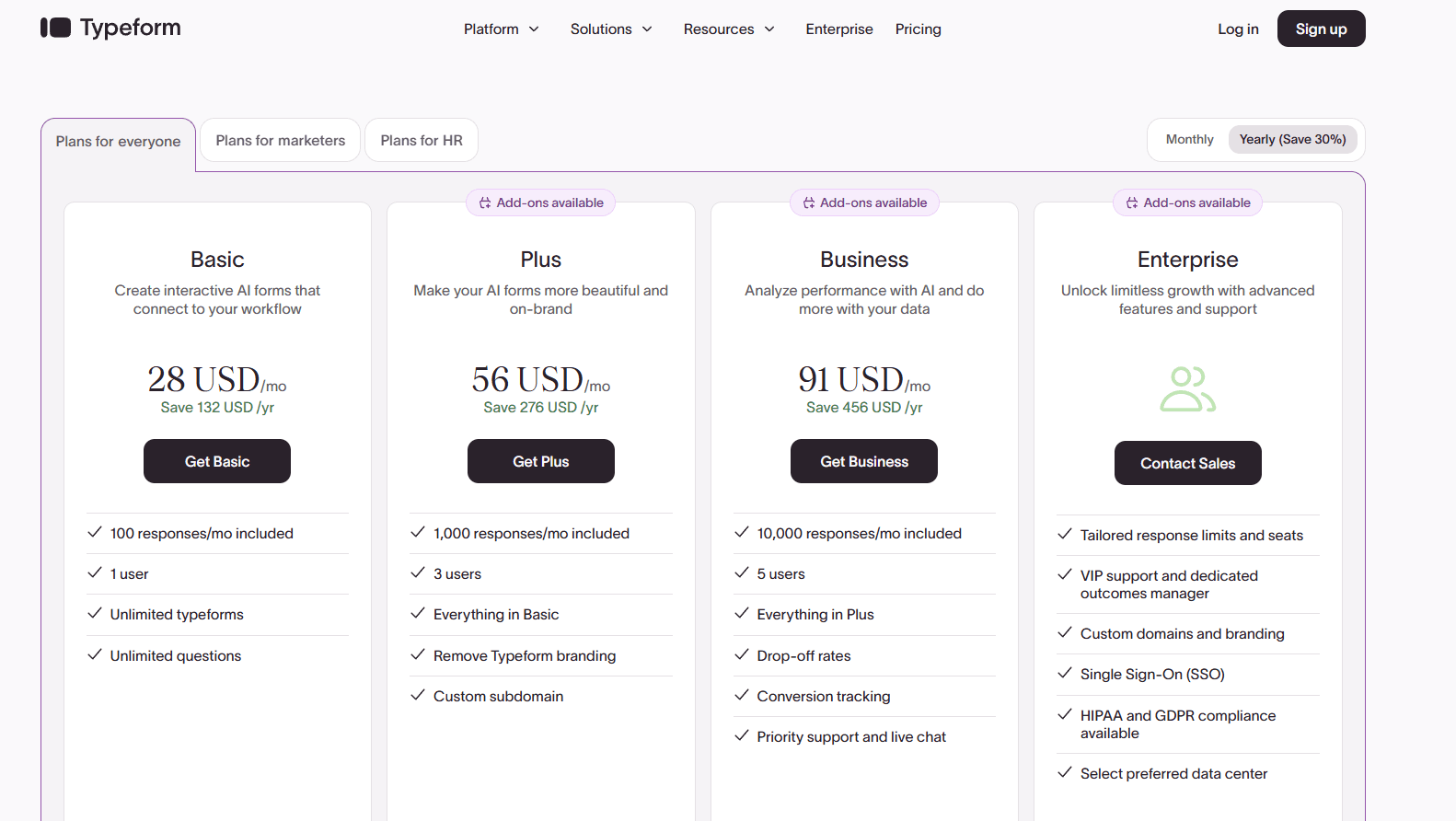
Typeform offers four pricing tiers: Basic ($39/month) for simple interactive surveys, Plus ($79/month) for stronger branding and higher response limits, Business ($129/month) for teams that need more advanced tracking and collaboration, and Enterprise (custom pricing) for large organizations that require improved security and dedicated support.
The biggest downside is that costs can climb quickly as your response volume increases.
Lower-tier plans also come with tight limits (such as responses and user seats), and many advanced features are only available on higher plans.
SurveyMonkey
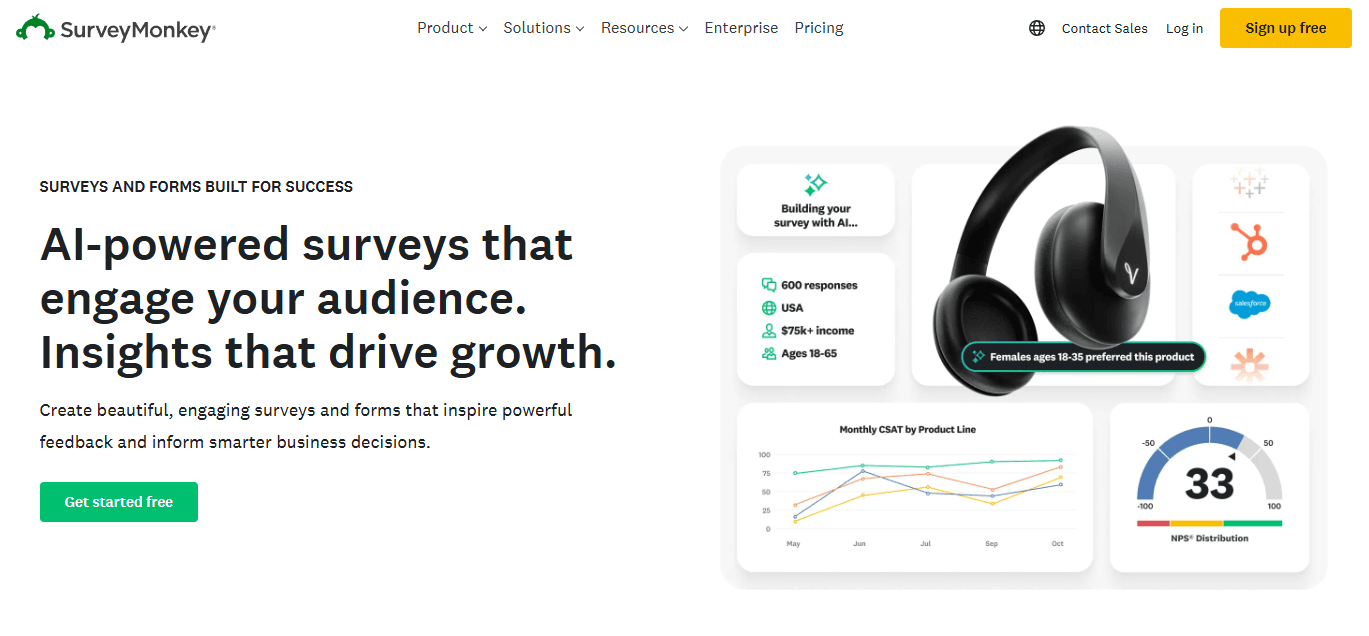
SurveyMonkey uses AI-powered survey creation to help you build polished, professional surveys faster. You can start with hundreds of expert-designed templates or design a custom survey from scratch.
It also makes distribution easy across multiple channels, including email, shareable web links, social media, SMS, QR codes, and embedded surveys on your website.
Best for
It’s a solid choice for businesses of any size that need reliable feedback. Use it to test new products, understand customer preferences, or track trends over time.
Key features
- Access to over 335 million potential respondents in 130+ countries
- 200+ targeting options, including age, gender, location, and job function
- Pre-built templates for market research
- Real-time results and analytics
- Custom screening questions to reach specific audience segments
- Data quality controls to ensure accurate results
- Custom reports, filters, and crosstab comparisons
- Results available in as little as one hour
Pricing overview
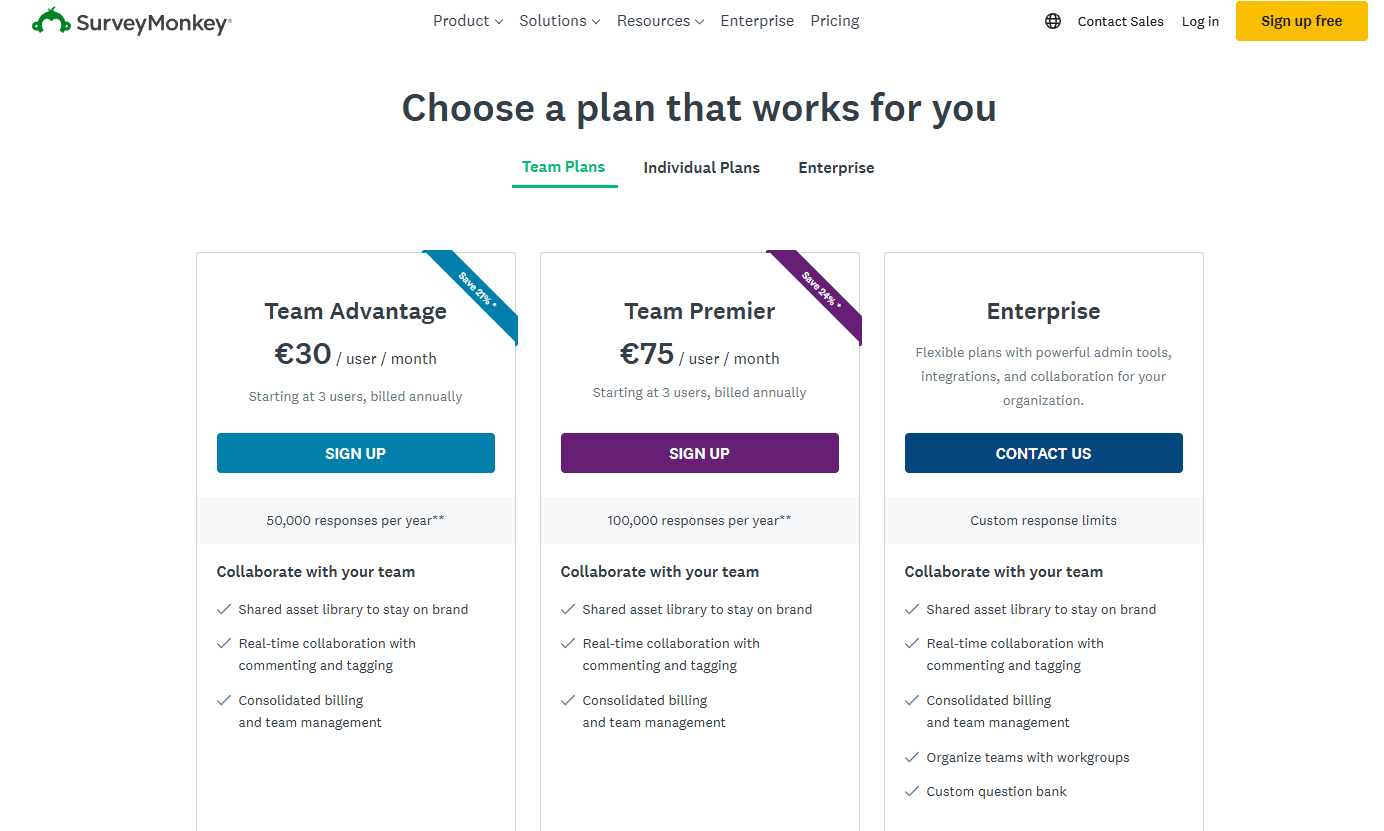
SurveyMonkey’s pricing is designed primarily for teams, with two core plans: Team Advantage (€30/user/month) and Team Premier (€75/user/month), both billed annually. For larger organizations, it also offers an Enterprise plan with custom pricing.
Team Premier supports a higher volume and includes more advanced features for running larger survey programs.
However, costs can rise quickly because pricing is charged per user, plans often require a minimum number of seats, and you may still need to upgrade if you reach yearly response limits or need more advanced capabilities.
Pollfish
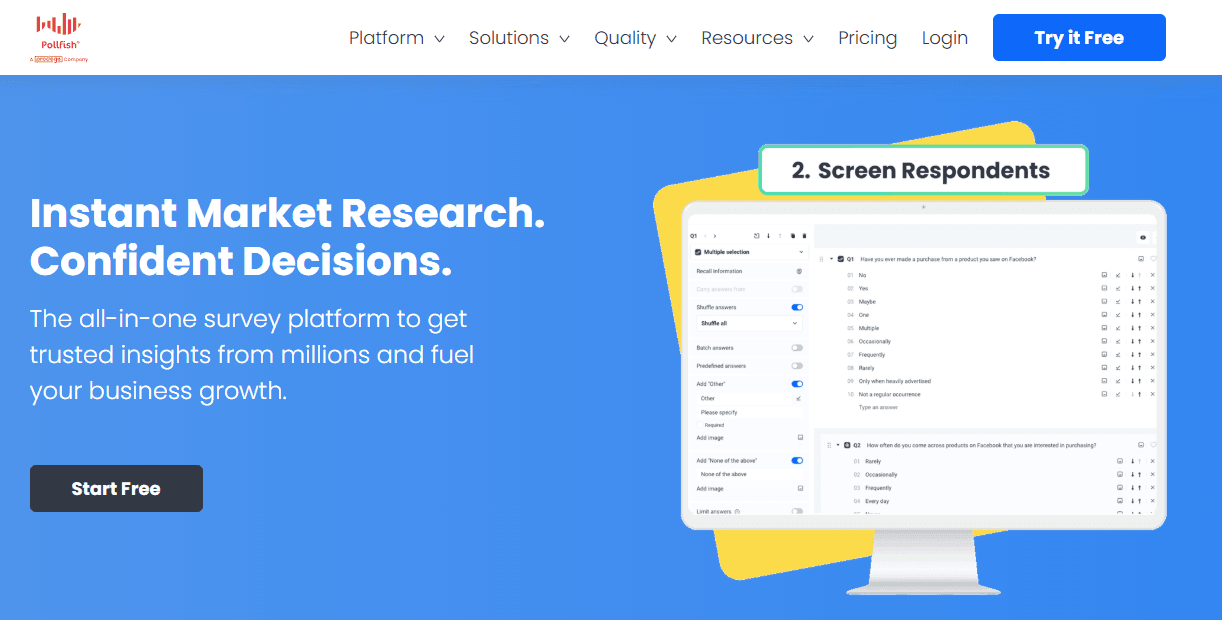
Pollfish is a mobile-first platform that connects you with real consumers through Prodege’s first-party panel.
You get access to millions of verified respondents who are already using apps and earning rewards, so you skip the professional survey takers who rush through for cash.
It works well when you need detailed audience targeting and quick results. You can launch surveys and get responses in hours or days.
The platform brings survey design, respondent recruitment, and analysis together in one place.
Best for
Businesses that need specific consumer segments and want to avoid fraud or low-quality answers. Product teams, marketers, and researchers who need quick turnarounds often choose Pollfish.
Key features
- 7,000+ targeting attributes across demographics, purchase history, app usage, and lifestyle
- AI-powered fraud detection blocks bots and fake responses in real time
- Nested quotas for complex samples
- Custom screening questions to find niche audiences
- Data visualization and reporting dashboards
- Multiple question types, including conjoint analysis and MaxDiff
- Skip logic and branching for personalized survey paths
Pricing overview
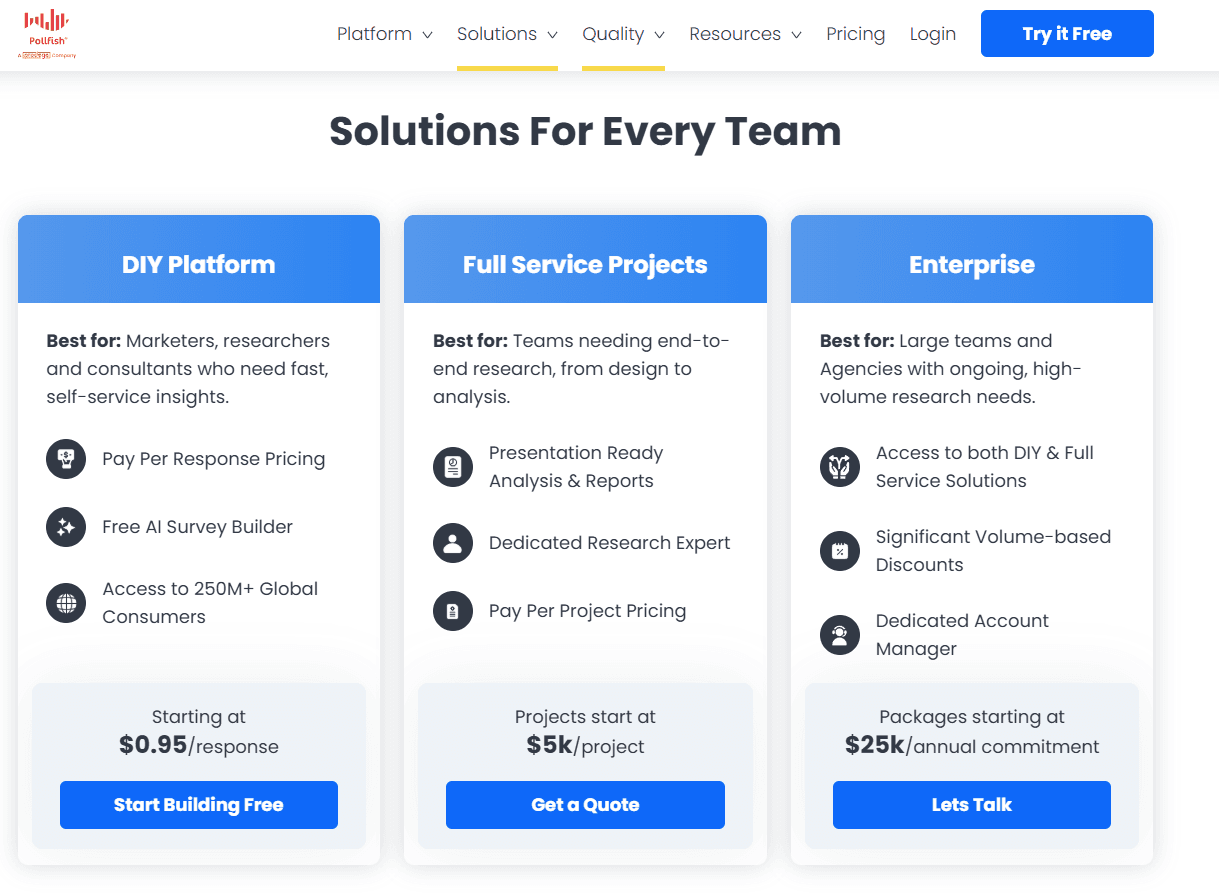
Pollfish offers three main pricing options based on the level of service you need. Its DIY Platform starts at $0.95 per response, which can work well for quick, self-service surveys.
The DIY plan can become costly as your sample size grows, since pricing increases with every response you collect.
Full Service and Enterprise tiers may also be out of reach for smaller businesses due to their high starting costs.
Why Porsline Is The Best Market Research Survey Tool
Porsline really takes the hassle out of trying to run market research. You can collect unlimited responses without extra fees, and all your data exports in one Excel file.
Advanced response quality controls
You get strong tools for clean data. Custom regex patterns let you collect responses in any format you want, and file upload questions can restrict certain file types. That means better info from the start.
Sophisticated grading and calculations
Porsline has built-in calculation features for complex scoring. You can create anything from simple quizzes to detailed assessments with custom grading formulas.
Improved security and access control
Porsline encrypts URL parameters, keeping your data safe when you share survey links. You can authenticate respondents through SMS verification or email domain restrictions. Choice-level quotas help you cap responses for specific options. It’s great for scheduling or limited spots.
Smarter data analysis
Advanced filtering tools let you focus on specific segments. Sort responses, customize chart colors, and slice data in different ways to find patterns faster and support data-informed decisions.
Additional features that make your market research easier
- Location detection for field research
- WhatsApp integration for live chat with respondents
- SMS and Telegram notifications for new submissions
- Customizable survey URLs
- Timer settings for timed tests
- Conversational or classic display modes
- Question randomization and answer keys for online testing
- Unlimited cloud storage expansion available
If you’re looking for a market research survey tool that helps you get deeper insights, supports competitive benchmarking, and makes it easy to gather thoughtful responses, Porsline deserves a serious look.
Start a free trial to see how it works.
Final Words About Market Research Survey Tools
Choosing the right market research survey software isn’t just a box to check. It can really shape the kind of deeper insights you get from your audience. Each market research tool out there brings something a bit different, depending on what you actually need.
What should you really consider before you run market research?
- Budget: Are you sticking to free tools, or do you need reporting tools and features that cost a bit more?
- Survey complexity: Will basic questions cut it, or do you need advanced logic to dig into consumer insights?
- Analysis needs: Do you just want simple charts, or are you craving deeper statistical analysis and competitive benchmarking?
- Integration: Does it play nicely with your other apps and platforms?
- Mobile experience: Will your surveys look decent on people’s phones and tablets, or will they bail out halfway?
Porsline stands out if you’re looking for balance. It’s built for market research, but it doesn’t skimp on customization or analytics. You’ll get a clearer picture of brand perceptions and what your audience actually cares about.
Curious about how it works? Start a free trial now.
FAQs About Market Survey Tools
What are the best market survey tools?
The best market survey tools depend on your goals, but the top picks are Porsline, SurveyMonkey, Typeform, Qualtrics, and Pollfish.
Porsline is great for fast, flexible surveys with multilingual support, while SurveyMonkey is a strong all-rounder for templates and analytics.
Typeform stands out for interactive, high-completion surveys, and Qualtrics is best for enterprise-level research and deep reporting.
Pollfish works when you need quick access to survey respondents with pay-per-response pricing.
What tools are used for market research?
Market research typically relies on survey platforms like Porsline, SurveyMonkey, Typeform, Qualtrics, and Pollfish to collect customer feedback, test ideas, and validate demand. These tools help teams gather data quickly, segment results, and turn responses into actionable insights.
How to conduct a survey for market research?
Start by figuring out what you want to learn. Pick a market research survey software that matches your budget and the features you need.
Write questions that are clear and simple, and try to avoid any sneaky bias. Test your survey with a small group first, just to catch anything weird.
Send your survey out through email, social media, or a panel. As responses roll in, keep an eye out for patterns or surprises in the data.
Can ChatGPT do market research?
ChatGPT can help with some research tasks, but it’s not a replacement for actual customer opinions. You can use it to draft questions, analyze open-ended responses, or even summarize key findings with reporting tools.
But let’s be real: it can’t collect real-time feedback or deliver those deeper insights you get from actual survey participants. You’ll need a solid market research tool and real respondents to make data-informed decisions.